How Did We Get Here?
Two years ago, a competent paid search manager could outperform Google’s automated bidding by carefully managing keyword lists, writing tailored ad copy for every ad group, and adjusting bids based on time-of-day performance data.
That era is largely over.
Not because those skills stopped mattering, but because the platforms evolved past the point where manual precision can keep up with algorithmic speed.
If you are running paid search for a manufacturing company, a DTC e-commerce brand, or any business where ad spend is a meaningful line item, the ground has shifted underneath you. The question is no longer whether to let AI into your campaigns. The question is whether you are giving AI the right inputs to optimize toward your actual business goals, or letting it optimize toward Google’s defaults.
Here is what has changed, what it means for your budget, and what to do about it.
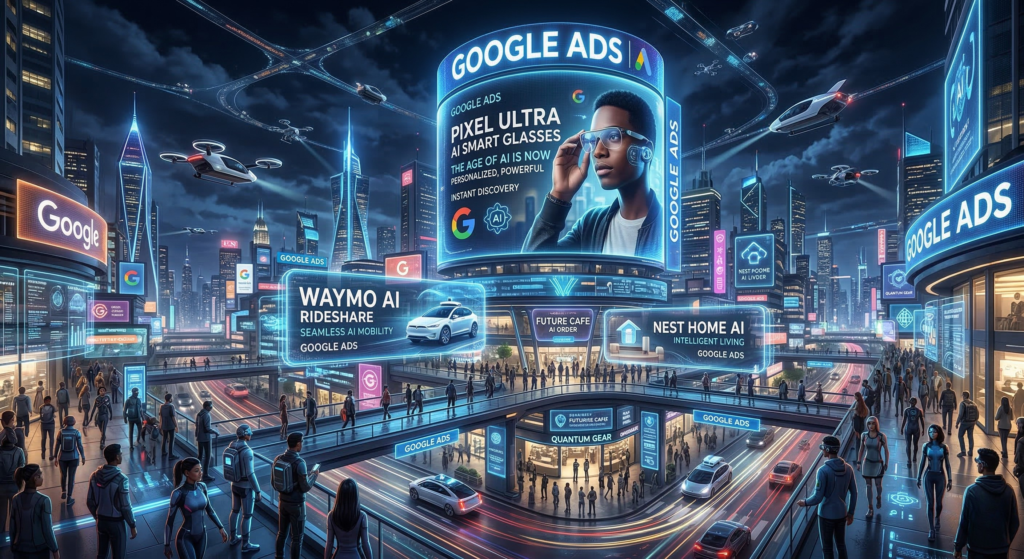
👆It’s kind of a trope… but now it’s generally true: the future is now
Google’s AI Infrastructure Is No Longer Optional
Google has spent the last three years systematically rebuilding its ad platform around AI. The changes are not incremental feature updates. They represent a fundamental architectural shift in how campaigns are structured, targeted, and optimized.
Performance Max has moved from experimental to essential. It runs across all Google inventory (Search, Display, YouTube, Discover, Gmail, Maps) from a single campaign, using Google’s AI to allocate budget and match creative to audiences in real time. For e-commerce brands, Performance Max campaigns connected to product feeds are now outperforming legacy Shopping campaigns in the majority of accounts. For B2B companies, the results are more mixed because Performance Max requires strong conversion signals to optimize effectively, and most B2B advertisers are still feeding it weak data like raw form submissions rather than qualified pipeline stages.
Broad match has been transformed. The broad match of 2022 that wasted budget on irrelevant queries is not the broad match of 2026. Google’s natural language processing now interprets search intent with significantly more nuance, and when paired with Smart Bidding, broad match keywords consistently surface high-intent queries that exact match strategies miss entirely. The tradeoff is that you must trust the algorithm with targeting while maintaining control through strategic inputs like audience signals, offline conversions, and negative keyword hygiene.
AI-generated ad copy is now native to the platform. Google’s automatically created assets and conversational campaign setup tools use generative AI to produce headlines, descriptions, and creative variations. The quality is improving rapidly, but it is still generic by default. Brands that feed their unique value propositions, technical differentiators, and audience-specific language into the system get materially better output than those who accept the defaults.
Meta’s Advantage+ Is Rewriting DTC Playbooks
On the Meta side, Advantage+ Shopping campaigns have become the default recommendation for e-commerce advertisers, and for good reason. By consolidating audience targeting, creative testing, and budget allocation into a single AI-driven campaign structure, Advantage+ eliminates much of the manual audience segmentation that used to define Meta advertising strategy.
For DTC founders managing high-AOV products, this shift creates both opportunity and risk. The opportunity is that Advantage+ can find profitable customer segments you would never have targeted manually, because the algorithm tests thousands of audience combinations simultaneously. The risk is that without accurate conversion data flowing back to Meta, the algorithm optimizes for the cheapest conversions rather than the most valuable ones.
This is where server-side tracking through tools like ClickMagick becomes critical. Meta’s Conversions API allows you to send purchase data, customer LTV signals, and even offline conversion events directly to the platform, bypassing the iOS privacy restrictions that degraded pixel-based tracking. The advertisers seeing the best results from Advantage+ are not the ones with the biggest budgets. They are the ones feeding the best data.
ChatGPT Ads and the Emergence of AI Search Advertising
One of the most significant developments in paid search for 2026 is the emergence of advertising within AI search platforms themselves. OpenAI has begun testing ad placements within ChatGPT search results, and Google’s AI Overviews are increasingly incorporating sponsored content.
This changes the paid search landscape in two important ways:
- New inventory means new opportunity. Brands that establish early presence in AI search advertising will benefit from lower competition and CPCs, similar to the early days of Google Ads. For categories where AI search is becoming a primary research tool (B2B procurement, high-consideration DTC purchases, technical product research), the early-mover advantage is real.
- Organic and paid visibility are converging. When your brand appears in an AI Overview as both a cited organic source and a sponsored result, the combined trust signal is more powerful than either alone. This is the intersection of GEO strategy and paid media strategy, and it is where 5K sees the most significant growth opportunity for clients across both manufacturing and e-commerce verticals.
The brands best positioned for AI search advertising are those already investing in Generative Engine Optimization (GEO) to make their content citable by AI platforms. Paid placement amplifies visibility, but the content behind the placement still needs to be structured for AI extraction. Advertising your way into an AI answer that links to a poorly structured page is a waste of spend. 5K’s approach to GEO and SEO is built specifically to ensure that both organic citation and paid amplification drive traffic to pages engineered for conversion.
What Smart Marketers Are Doing Differently
| Practice | What It Means | Why It Matters |
| Revenue Data Feedback | Importing closed-deal revenue, pipeline stage data, and customer LTV from your CRM back into Google Ads and Meta | Shifts algorithmic optimization from cheapest conversions to highest-value outcomes. The single highest-leverage change most advertisers can make. |
| Consolidated Campaign Structures | Running fewer campaigns with broader targeting and more creative variation instead of dozens of hyper-segmented ad groups | Gives the algorithm more data per campaign to learn from, reducing signal fragmentation that undermines AI optimization |
| Full-Funnel Measurement | Using independent attribution (ClickMagick) and unified visibility tracking (5K Analytics) alongside platform-native reporting | Reveals how paid search interacts with organic discovery, AI citation, and downstream revenue so budget decisions are based on complete data |
| Strategic Growth Alignment | Identifying the highest-value offering first (Impact Offering via ProfitPaths®) and building paid, organic, and AI visibility around it in a coordinated sequence | Paid media managed within an integrated growth strategy (like 5K’s RAMP!™ roadmap) consistently outperforms paid media managed in isolation |
The marketers getting the best results from AI-driven paid search in 2026 share a few common practices that separate them from those watching performance erode.
They are feeding revenue data back into the platforms.
Not just conversions. Actual revenue, pipeline stage data, and customer lifetime value. This is the single highest-leverage change most advertisers can make, and it is still surprisingly uncommon. Google and Meta’s AI systems are only as smart as the data they receive. When you tell the algorithm that a $50,000 closed deal started with a specific ad click nine months ago, you fundamentally change what it optimizes for going forward.
They are consolidating campaign structures.
The era of 40 ad groups with 15 keywords each is ending. High-performing accounts are running leaner structures with fewer campaigns, broader targeting, and more creative variation. This gives the algorithm more data per campaign to learn from and reduces the signal fragmentation that undermines AI optimization.
They are measuring across the full funnel, not just the last click.
Tools like ClickMagick for independent attribution and 5K Analytics for unified SERP and AI visibility tracking give marketers a complete picture of how paid search interacts with organic discovery, AI citation, and downstream revenue. Without this visibility, you are making budget allocation decisions with incomplete information.
They are aligning paid strategy with a broader growth framework.
The most effective paid search programs are not standalone. They operate within a strategic architecture that identifies the highest-value offering first (what 5K calls the Impact Offering, identified through ProfitPaths®), then builds paid, organic, and AI visibility around that offering in a coordinated sequence. This is the approach behind 5K’s RAMP!™ strategic roadmap, and it is the reason paid media managed as part of an integrated growth strategy (like 5K’s paid traffic management services) consistently outperforms paid media managed in isolation.
Learn why you need to align your paid ads strategy with your IMPACT Offering 👇
The Bottom Line
AI has not made paid search easier. It has made paid search different. The tactical skills that used to differentiate great campaign managers are being absorbed by the platforms. What differentiates great results now is strategic clarity: knowing exactly which product or service to push, feeding the algorithm real business outcomes instead of proxy metrics, and measuring performance across a landscape that now includes traditional search, AI search, and organic citation.
If your paid search feels like it is getting more expensive and less effective, the problem is probably not your budget. It is probably that your campaign architecture was built for a version of paid search that no longer exists.
The good news is that the shift to AI-driven paid search, managed strategically, is genuinely better for advertisers who sell high-value products and services. Algorithms that optimize toward lifetime value and pipeline revenue will always outperform algorithms optimizing toward cheap clicks. You just have to give them the data to do it.