June 16, 2026
Speed to Lead: Why the First Five Minutes Decide Whether a Lead Becomes Revenue
Speed to lead turns more inbound inquiries into revenue. Learn why five-minute follow-up wins and how automated outreach stops paid leads from going cold.
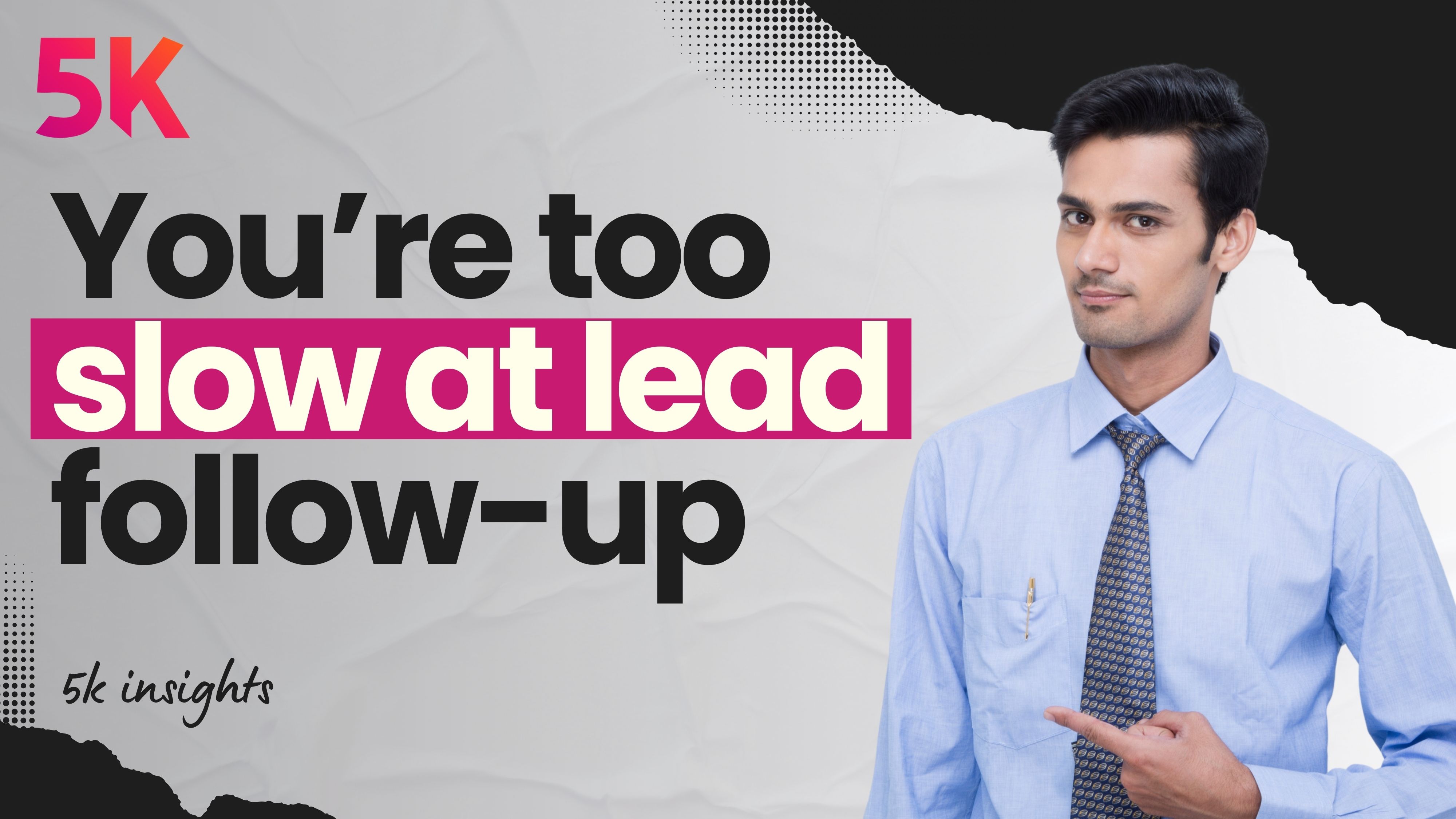
Speed to lead is how fast your business responds to a new inquiry, and it is the single most powerful, most overlooked driver of how many of your leads turn into revenue.
When someone fills out your form, requests a quote, or books a call, their intent is at its absolute peak in that moment, and it decays by the minute. Leads contacted within five minutes are 21 to 100 times more likely to convert than leads contacted after thirty. Respond in under a minute and conversion can climb by nearly 400%.
Yet the average company takes 42 hours to respond, and over 60% never respond at all. That gap, between how fast buyers expect an answer and how fast most businesses actually deliver one, is where the majority of marketing budgets quietly leak.
This piece is about why the window is so short, what it is costing you, and how to win it on every lead without burning out your sales team.
The physics of intent decay
Every inbound lead arrives hot and cools on a clock you do not control. The moment a prospect hits "submit," they are leaning in, comparing options, ready to talk, motivated. They are also, in that same moment, filling out two or three of your competitors' forms. Whoever reaches them first while the intent is still live usually wins, and it is not close: 78% of customers buy from the first company that responds, regardless of who had the better price.
The data on this is brutal and consistent. A five-minute delay slashes the odds of even qualifying the lead by 80%. Wait an hour and you are ten times less likely to make meaningful contact than if you had called in the first five minutes. Wait a day, which is still faster than the 42-hour corporate average, and you are sixty times less likely to qualify that lead than a company that answered within the hour. None of this is about persuasion or pricing. It is about timing. The lead was winnable for about five minutes, and most businesses spend those five minutes letting the submission sit in an inbox.
Here is the part that should sting: you already paid for that lead. You paid for the ad click, the SEO content, the landing page, the trade-show booth. The most expensive money in your entire funnel is the money you spend generating an inquiry you then let go cold. Slow follow-up does not just lose a sale. It throws away the acquisition cost that bought the chance at it.
Speed signals everything else about you
There is a psychology underneath the numbers, and it explains why the effect is so large. A near-instant response is the digital equivalent of a warm greeting when you walk into a store. It signals that the company is organized, responsive, and easy to do business with, exactly the things a buyer is unconsciously evaluating before they hand over money. A slow response signals the opposite, and the prospect extrapolates: if this is how they treat me when they are trying to win my business, what happens after I have paid?
That is why 66% of buyers now say speed is as important to their decision as price. The first interaction is a preview of the whole relationship, and buyers read it that way. Responding fast is not a sales tactic. It is the first proof you deliver on anything.
Why "we follow up with every lead" usually is not true
Most leaders believe their team follows up promptly. The reality on the ground is almost always slower and patchier than they think, and not because anyone is lazy. It is structural.
Leads come in at 9 p.m., on Saturdays, over holidays, and in clusters right when a rep is already on a call. A human cannot watch the inbox every minute of every day, and the moments leads arrive are rarely the moments a salesperson is free. So the lead waits, an hour, a morning, a weekend, and by the time someone dials, the window is gone. Worse, follow-up dies fast: most reps stop after one or two attempts, while 70% of positive replies come between the second and fourth touch. The leads do not get worked. They get touched once and abandoned.
Relying on a human being to manually hit a sub-five-minute response time, on every lead, around the clock, forever, is a mathematical impossibility. Fewer than 5% of organizations ever pull it off. This is not a discipline problem you can solve with a pep talk or a new commission structure. It is a systems problem, and it needs a systems answer.
The fix: automate the first five minutes, then orchestrate the next two weeks
This is the core of the lead follow-up methodology we build for clients, and it has two parts: an instant automated response that fires the second a lead comes in, and a structured multi-channel cadence that works the lead for the two weeks after.
We call the first part the Vanguard Response. The goal is to make contact in under sixty seconds, automatically, on 100% of inbound leads. The moment a form is submitted, a trigger fires a coordinated, simultaneous outreach across three channels:
- An immediate AI voice call. A conversational AI voice agent, not a clunky press-1 phone tree, but a natural, low-latency assistant, calls the prospect within seconds, references the exact service they asked about, answers basic questions, lightly qualifies them, and offers calendar slots to book time with a human. A documented home-services deployment of this exact pattern took average callback time from 5.4 hours down to 58 seconds and roughly tripled its lead-to-appointment rate on the same ad spend and lead volume. The lift did not come from spending more. It came from stopping the leak.
- An instant SMS. If the call is not answered, a text fires immediately to validate the missed call and hand over a one-tap scheduling link. SMS carries a 98% open rate and an average response time of about 90 seconds. It cuts through where email cannot. Pairing the call with an instant follow-up text is a tactic the data calls the "double tap," and it meaningfully lifts contact rates.
- A contextual email. A personalized email lands with a relevant buyer's guide or resource, establishing authority while the prospect is still actively researching.
The point is not the technology for its own sake. The point is that automation is the only mechanism that can reliably cross the sixty-second threshold on every lead, at 2 a.m., on a holiday, while your team sleeps. It guarantees that no inquiry ever sits unworked while its intent quietly drains away.
If the Vanguard Response does not book the appointment, the lead drops into a 14-day omnichannel cadence: eight to twelve touches across voice, SMS, email, and social, front-loaded into the first week when intent is still recoverable and tapering after. A few principles make it work instead of annoy:
- Every message earns its place. "Just checking in" is forbidden. It offers zero value and trains the lead to ignore you. Each touch shares a useful resource, deploys a relevant case study, removes a specific objection, or asks one low-friction question.
- Multiple channels compound. Reaching someone across four or more channels generates dramatically more responses than email alone. Published benchmarks put the uplift near 860% over email-only because each channel is a fresh chance to break through inbox fatigue.
- It stops the instant a human engages. The most important rule in any automated sequence: the moment the prospect replies, answers, or books, every automated touch halts and the lead is handed to a person. Automation handles the speed and the persistence. Humans handle the conversation that closes.
That last point matters. Done right, this does not replace your salespeople. It protects their time. The system does the tireless, around-the-clock dialing and texting that humans cannot sustain, and only routes a prospect to a rep once they have raised their hand. Your most expensive people spend zero minutes chasing cold leads and all their minutes in live, revenue-generating conversations.
This is a ProfitPaths® problem, not a sales problem
It is tempting to file speed to lead under "sales operations" and move on. That is the mistake. In our ProfitPaths® methodology, the path from a click to a closed deal runs through a specific, fragile step we call Prospect-to-Lead Conversion: the handoff where interest becomes a real, worked opportunity. Speed to lead is the make-or-break moment of that step. You can have the right offer, the right customer, a great paid media program, and a website that converts and still pour the results down the drain in the gap between the form submission and the first response.
This is exactly the kind of leak that hides between the deliverables, where a single-channel vendor cannot see it. The ad agency reports great cost-per-lead. The web team reports strong form-fill rates. Everyone's dashboard is green. And revenue still disappoints, because the one number nobody owns, how fast does an inbound lead actually get worked, and how persistently, is the number quietly deciding the outcome. A true growth partner follows the problem across that gap and puts an automated system on it, because that is where the money was leaking the whole time.
The executive test
You do not need a consultant to find out whether you have this problem. You need one experiment. Have someone fill out your own website's contact form right now, as a stranger would, and time how long it takes to get a real response. Not an auto-reply receipt. A human-quality attempt to actually engage and book a conversation.
If the answer is measured in hours or days, you have just found one of the highest-return fixes available to your business, and you have found it for free. You are already paying to generate these leads. Closing the speed gap does not require a bigger budget, a new channel, or more traffic. It requires making sure the leads you already buy get answered while they are still worth answering. Most of your competitors take 42 hours. Beating them is not a matter of spending more. It is a matter of being first.
Ready to Stop Losing the Leads You Already Paid For?
If you are spending real money to generate inquiries and cannot say how fast, or how persistently, each one actually gets worked, that is almost certainly where your funnel is leaking the most profit. We will map your current speed to lead, show you exactly where leads are going cold, and build the automated follow-up system that contacts every inbound lead in under a minute and works it for two weeks straight.
5K Team
Our team helps companies to increase revenue, decrease costs, increase efficiency, and scale employees using digital marketing and AI technology.