Every scaling business hits the same inflection point. You’re growing, hiring rapidly, and suddenly the systems that worked when you were a team of five are failing at fifteen. Deals slip through cracks. Quality becomes inconsistent. Your best people spend half their day answering the same questions. You realize the bottleneck isn’t talent or market opportunity but the absence of documented, repeatable processes. So how do you use SOPs for business growth strategies?
SOPs drive business growth by converting tribal knowledge into scalable systems, enabling consistent execution across teams, reducing operational costs by up to 30%, and freeing leadership to focus on strategic initiatives rather than daily firefighting.
Need help locking in a repeatable business growth strategy that can actually grow your business? That’s why 5K exists.
Why We’re Writing This Article
As I’m writing this, it doesn’t feel as “big picture” or strategic as our content typically does… but I think that’s a good thing.
For starters, I decided to search this question in Ahrefs, and it’s one of the top questions asked under the head term “business growth strategies”.
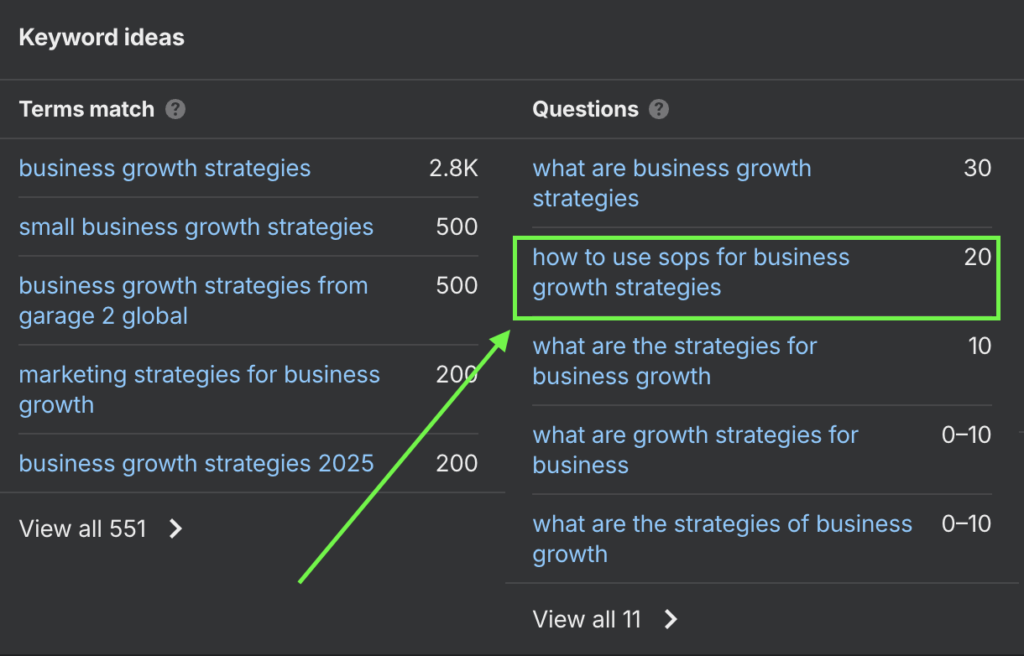
People are asking. We’re answering.
The other important thing about this content — and what I hope to underscore — is, sometimes the full-tilt focus on “strategic” ends up being a forest for the trees situation (Dave, our CEO, actually doesn’t even like that word… “it’s often filler,” he says).
If we neglect the “small things” (that really aren’t so small), we’re in danger of the talents and skills within our companies and organizations amounting to nothing because, well, there isn’t any organization within our companies. SOPs aim to solve this issue by standardizing brilliant thought processes that come naturally to some, but not to others.
We decided to write this content as we were revamping our own SOPs at 5k. After helping dozens of companies build growth marketing strategies that actually scale, we kept seeing the same pattern: the businesses that grew predictably were the ones that had documented their repeatable processes early.
The ones that plateaued were constantly reinventing the wheel. That realization forced us to audit our own operations. We had brilliant strategies but needed to enhance how easily repeatable they were to execute. If someone with no working knowledge of our internal processes sat down at my desk and read through one of our SOPs, would they know what to do and how to execute the strategy, campaign buildout, etc.? That became the north star.
And that’s what we’re here to help you with in this article.
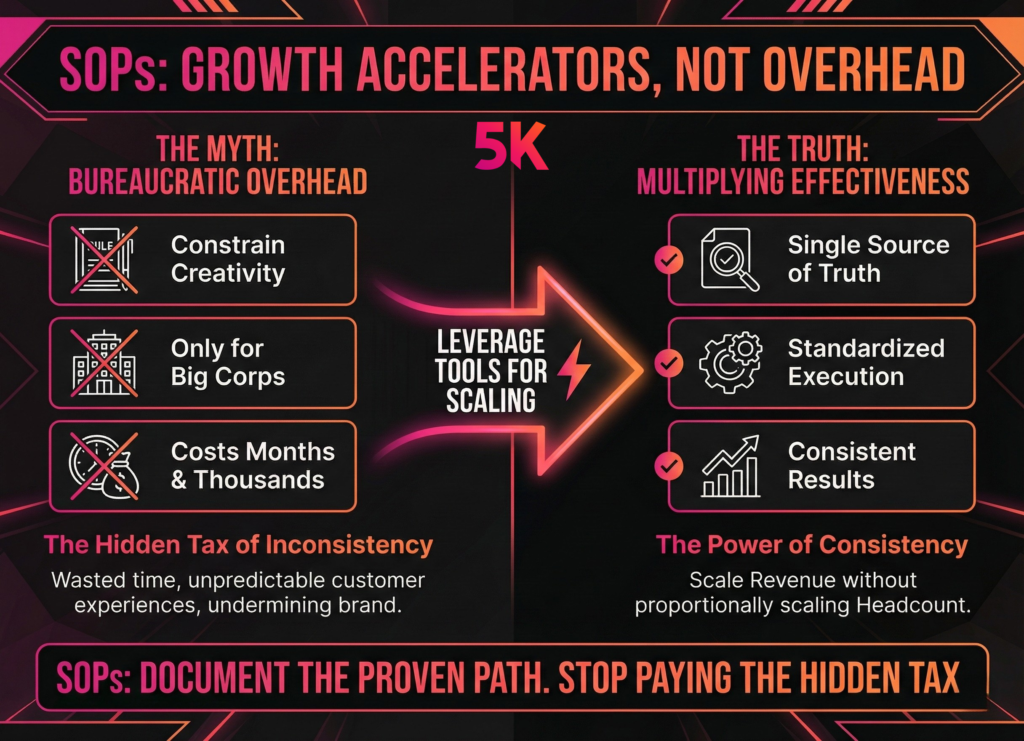
Why SOPs Are Growth Accelerators, Not Administrative Overhead
Most founders treat standard operating procedures as bureaucratic paperwork best suited for enterprises or franchises. That misconception costs them months of progress and thousands in wasted resources. SOPs are not rulebooks designed to constrain creativity. They are leverage tools that multiply your team’s effectiveness.
When you document the proven path to completing a task, you stop paying the hidden tax of inconsistency. Customer onboarding that takes one rep 20 minutes and another rep two hours represents inefficiency you’re funding every single day. Quality control that depends on whoever happens to be working that shift creates unpredictable customer experiences that undermine your brand positioning.
SOPs eliminate these inefficiencies by creating a single source of truth. They capture what works, standardize execution, and ensure that your business delivers consistent results regardless of who’s executing the work. This consistency is what allows you to scale revenue without proportionally scaling headcount.
At 5K, we slash inefficiencies through IA (intelligent automation) to save you money and help you actually grow your business. If you need help optimizing those mundane (but important) tasks eating into valuable payroll — all while growing your business through strategic digital marketing, we’ve got you covered.
Building SOPs That Drive Measurable Business Outcomes
Creating effective SOPs requires more than documenting what your team currently does. You need to reverse-engineer from the business outcomes you want to achieve. Start by identifying your growth bottlenecks through 88data, not assumptions.
Look at your business metrics and ask where variation creates drag:
- High customer churn often points to inconsistent onboarding.
- Long sales cycles might indicate unclear qualification criteria or proposal processes.
- Support tickets that escalate frequently suggest frontline teams lack decision-making frameworks.
Each of these problems represents an opportunity for an SOP that removes friction.
When building your procedures, focus on three elements.
- First, define the desired outcome clearly.
- Second, document the minimum viable steps to achieve that outcome consistently.
- Third, specify decision points where judgment is required and provide frameworks for making those decisions.
SOPs should reduce cognitive load, not increase it.
The format matters less than clarity. A simple checklist works better than a 40-page manual that nobody reads. Many high-growth companies use video walkthroughs paired with one-page reference guides. We do this.
The goal is making the right behavior the easiest behavior.
Connecting SOPs to Your Revenue Engine
The real power of SOPs emerges when you align them with your customer acquisition strategy and revenue operations. Every touchpoint in your customer journey should have a corresponding procedure that ensures consistency.
For your marketing operations, SOPs should cover campaign planning, content production workflows, lead scoring criteria, and performance review cadences. This documentation allows you to replicate successful campaigns systematically rather than hoping for lightning to strike twice. When your paid advertising campaigns convert at 4% instead of 2%, you can examine what was different, document it, and make it the new standard.
Your sales process demands even tighter SOPs. Document your qualification frameworks, pitch structures, objection handling approaches, proposal creation, and closing sequences. These procedures don’t script every conversation but rather ensure every prospect receives the same high-quality experience. Inconsistent sales processes create inconsistent revenue, which makes forecasting and planning nearly impossible.
For customer success, SOPs determine whether customers realize value quickly or churn within months. Document your onboarding sequences, check-in cadences, expansion conversation triggers, and renewal processes. These procedures transform customer success from art into science, making retention predictable rather than hopeful.
Using SOPs to Scale Without Sacrificing Quality
The test of any SOP comes during rapid scaling. When you double your team size in six months, documentation is what prevents quality from collapsing. New hires can become productive in weeks instead of months when they have clear procedures to follow.
This accelerated onboarding has compounding effects. Faster time-to-productivity means new employees contribute to revenue sooner. Reduced training burden means existing team members spend less time teaching and more time executing. Better consistency means fewer mistakes that damage customer relationships or create rework.
SOPs also enable effective delegation, which is essential for founder-led businesses trying to scale. When critical processes live only in your head, you become the bottleneck. Document those processes, and you can delegate them to team members while maintaining confidence in the outcome.
The key is treating SOPs as living documents rather than static rulebooks. Schedule quarterly reviews where team members who use the procedures daily can suggest improvements. When someone discovers a better way to accomplish a task, update the SOP and train everyone on the improvement. This continuous refinement prevents SOPs from becoming outdated or disconnected from reality.
“[5K] is our go-to for all things digital. We’ve worked with them on two big projects— both turned out phenomenally well….great experience with them on both. Professional, great communicators, easy to work. They know their stuff, and it shows—I highly recommend!” – Brandon Baker, Monocacy
Measuring the Growth Impact of Your SOP Implementation
SOPs should drive measurable improvements in business performance. Establish baseline metrics before implementation, then track changes over time. Common metrics include time to complete key processes, error rates, customer satisfaction scores, and employee productivity.
For example, if you implement an SOP for customer onboarding, measure time-to-first-value before and after. Track how long it takes new customers to complete setup and experience their first win. Many companies see this metric improve by 40-60% after standardizing their onboarding sequence.
Similarly, track quality metrics. If you standardize content production, measure engagement rates, conversion rates, and the percentage of assets that meet your quality standards on the first review. SOPs typically reduce revision cycles significantly while improving output quality.
Financial metrics matter too. Calculate the cost per completed task before and after SOP implementation. Many businesses discover they can reduce operational costs by 20-30% simply by eliminating wasted effort and rework. These savings can be reinvested in growth initiatives.
Advanced SOP Strategies for Competitive Advantage
Once you’ve established foundational SOPs, you can leverage them for strategic differentiation. Start building processes that encode your unique intellectual property and competitive advantages.
If your growth marketing expertise comes from a proprietary approach to customer research, document that methodology in detail. If your sales team has discovered a questioning framework that consistently uncovers hidden pain points, codify it. These procedures become your competitive moat because they allow you to replicate excellence that competitors can’t easily copy.
Consider building cross-functional SOPs that integrate multiple departments. For example, create procedures that connect marketing qualified leads to sales accepted leads to customer onboarding. This integration eliminates handoff failures that typically plague growing businesses. When every department understands how their work feeds into the next stage, you create organizational alignment that competitors struggle to match.
Think about building SOPs for strategic initiatives, not just operational tasks. Document your product launch process, market entry strategy, partnership development approach, and crisis management protocols. These strategic SOPs ensure you can execute major initiatives consistently even as team members change.

Common SOP Implementation Failures and How to Avoid Them
Many businesses invest time creating SOPs only to see them ignored. The most common failure is building procedures in isolation without input from the people who will use them. When SOPs are handed down from management without frontline team input, they often miss critical details or mandate impractical approaches.
Instead, involve your team in SOP creation. Have the people currently doing the work document their process, then have others review and test it. This collaborative approach ensures procedures reflect reality while building buy-in from the people who need to follow them.
Another frequent mistake is over-complicating procedures. If your SOP for sending a proposal is seven pages long, nobody will read it. Simplicity beats comprehensiveness. Focus on the critical steps that prevent the most common errors, not exhaustive documentation of every possible scenario.
Lack of training also undermines SOP effectiveness. Creating a document and uploading it to your shared drive doesn’t mean anyone will use it. Schedule training sessions where team members practice following new procedures with supervision. Provide feedback, answer questions, and refine the SOP based on what you learn during training.
Finally, many companies fail to enforce SOP usage. If following procedures is optional, people will default to their individual methods. Make SOP adherence a performance expectation. Review work against documented standards and provide coaching when deviations occur. This accountability ensures procedures actually shape behavior rather than gathering digital dust.
Integrating SOPs Into Your Growth Operating System
SOPs are most powerful when integrated into your broader operational rhythm. Connect procedures to your meeting cadences, reporting structures, and performance management systems.
For instance, use your weekly team meetings to review SOP adherence and identify improvement opportunities. Make procedure updates a standard agenda item in monthly operations reviews. Include SOP creation and refinement in quarterly planning sessions as you prepare for new initiatives.
Link SOPs to your performance management by making procedure mastery a component of employee development. New hires should demonstrate proficiency with core SOPs as part of their probation period. Experienced team members should contribute to SOP development as part of their growth into leadership roles.
Consider appointing process owners who are accountable for specific SOPs. These individuals monitor usage, gather feedback, coordinate updates, and ensure the procedure remains effective. This ownership creates clear accountability for process excellence.
As your business grows, your SOP library should grow with it. Start with your highest-impact processes, then systematically document supporting procedures over time. Within 18 months, most businesses can have 80% of their core operations documented, creating a foundation for confident scaling.
The companies that dominate their markets don’t just have better strategies. They have better systems for executing those strategies consistently. SOPs are how you transform strategic vision into operational reality, enabling predictable growth that your competitors can’t match.