Autonomous paid media is the practice of configuring AI-driven advertising systems with strategic business inputs (profit margins, lifetime value data, pipeline signals, and offline conversions) so that bidding, audience discovery, and budget allocation are executed by machine learning rather than manual human management.
For industrial brands with long sales cycles and high-value transactions, this approach solves the fundamental mismatch between traditional campaign management and the complexity of modern B2B buying behavior. 5K’s methodology for autonomous paid media begins with ProfitPaths® to identify the highest-impact offering before a single dollar is allocated to algorithmic execution.
Too busy to read the whole article? We absolutely recommend you share it with your team, but here’s your big takeaway as a busy CEO:
THE CEO TAKEAWAY: Your paid media isn’t underperforming because of budget. It’s underperforming because a manual campaign structure can’t feed revenue data back to the algorithm, so the machine never learns what a good lead looks like for your business. Autonomous paid media fixes that by connecting your CRM pipeline data directly to Google and Meta’s AI, letting the system optimize toward closed deals instead of form fills. The result: marketing spend you can actually trace to revenue, reported on a timeline that matches your real sales cycle. That’s the shift from “what did we get for $40K?” to “Q1 ad spend generated $1.2M in closed pipeline by Q3.
A Familiar Scene in Every Manufacturing Conference Room
Story time.
It is a Tuesday morning quarterly business review. The VP of Sales has a pipeline report showing that three of the company’s five largest deals in Q1 came from trade show leads and direct referrals. The CEO turns to the marketing director and asks a version of the same question that gets asked every quarter:
“We spent $40,000 on Google Ads last month. What did we get for it?”
The marketing director pulls up a Google Ads dashboard showing:
- 1,200 clicks
- 3.2% click-through rate
- 47 form submissions
The CEO asks how many of those form submissions turned into qualified opportunities. The marketing director does not have that answer readily available because the CRM data and the ad platform data live in different systems, and the 14-month sales cycle for their capital equipment means last month’s ad clicks will not show revenue impact until late next year.
Long pause… no answer (shoutout to my wife’s favorite movie as a teenager for supplying me with this quote).
The CEO suggests cutting the ad budget (marketing — like music classes at the local middle school — is always the first to go).
The marketing director argues they need more budget for better results. Neither of them is wrong, but neither of them has enough data to make the right call.
This scene plays out in manufacturing companies every quarter, and it is not a people problem. It is an infrastructure problem. The manual, platform-native approach to paid media wasn’t really designed for B2B industrial sales cycles, and no amount of spreadsheet reconciliation can fix what is fundamentally a system architecture gap.
Autonomous paid media closes that gap. Not by removing humans from the process, but by restructuring which decisions humans make and which decisions machines make.
Why Manual Bidding Is Failing Industrial Brands in 2026
Manufacturing paid media operates under conditions that break traditional campaign management models. It’s kind of a trope at this point, but “we’re not selling widgets here…”.
Understanding why manual approaches are failing requires looking at four structural realities. So let’s get into them.
#1 Industrial B2B audiences are extremely small and extremely valuable
A manufacturer of custom hydraulic cylinders for mining equipment might have a total addressable market of 300 companies in North America. Each contract is worth $200,000 or more over its lifetime. The math of paid media changes completely when you are not targeting millions of consumers but a few hundred decision-makers.
Manual keyword bidding treats every click as roughly equivalent. AI-driven systems can learn which behavioral patterns within that small audience correlate with actual pipeline progression and allocate spend accordingly.
#2 Sales cycles of 6 to 18 months make short-window conversion tracking meaningless
Google Ads default attribution looks back 30 to 90 days. When your average deal takes 14 months to close, the platform literally cannot see whether its optimization is working. Manual bid managers compensate by optimizing for proxy metrics like form fills and content downloads. But a form fill from a plant manager researching a capital purchase is worth 500 times (ballpark, but an accurate ballpark figure) more than a form fill from a student writing a research paper. Without revenue data flowing back into the system, optimization is guesswork wearing an analytics costume.
#3 CPC inflation in technical niches punishes inefficiency
Keywords like “custom CNC machining services” or “industrial automation integrator” can run $25 to $75 per click. At those prices, every click that reaches the wrong person is a significant waste. Manual campaign managers try to solve this with negative keyword lists and tight match types, but Google’s own systems have moved aggressively toward broad match and AI-driven matching. Fighting the platform’s architecture is a losing proposition. Working with it, by feeding it better strategic data, is ultimately where the leverage exists.
#4 Google and Meta are no longer optional AI partners
Performance Max, broad match with Smart Bidding, and Meta’s Advantage+ campaigns are not features you can ignore. They are becoming the default infrastructure of paid media (Meta is pushing towards Andromeda for instance). Google has made it clear that advertisers who feed better data into their AI systems get better results, and advertisers who try to maintain full manual control will increasingly find themselves outbid by competitors whose machines are learning faster.
The manufacturing CMO watching ROAS decline quarter over quarter is not seeing a failure of paid media. They’re not even really seeing a failure of their marketing team. They are seeing the failure of a manual approach inside a system that has become fundamentally algorithmic.
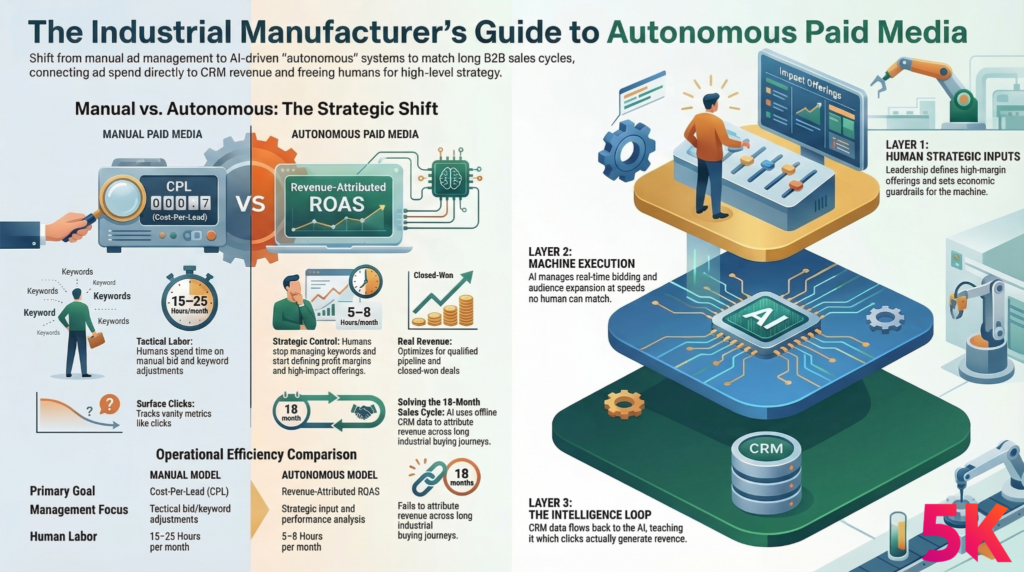
Manual vs. Autonomous Paid Media: A Side-by-Side Comparison
The following table summarizes the key differences between traditional manual campaign management and the autonomous approach 5K implements for industrial brands.
| Dimension | Manual Paid Media | Autonomous Paid Media (5K Approach) |
| Bid Management | Human-set CPCs adjusted weekly or monthly | AI-driven Smart Bidding optimizing toward offline revenue data in real time |
| Keyword Strategy | 200–500+ exact/phrase match keywords with manual negatives | 10–30 broad match keywords feeding algorithmic intent matching |
| Audience Targeting | Static audience lists built from demographic assumptions | Dynamic AI audience expansion based on behavioral conversion patterns |
| Conversion Signal | Platform-reported form fills and page views (30–90 day window) | Offline CRM data including pipeline stage, closed-won revenue, and LTV (12–18 month window) |
| Optimization Goal | Cost-per-lead or on-platform ROAS | Cost-per-qualified-opportunity and revenue-attributed ROAS |
| Strategic Foundation | Campaign-level targeting based on product catalog | ProfitPaths® Impact Offering identification based on margin and competitive analysis |
| Reporting | Platform dashboards with click and conversion metrics | Unified view via 5K Analytics (analytics.5k.co) combining paid, organic, and AI citation visibility |
| Typical Monthly Management Hours | 15–25 hours of tactical bid and keyword adjustments | 5–8 hours of strategic input refinement and performance analysis |
| Time to Algorithmic Learning | N/A (no algorithmic feedback loop) | 60–90 days to meaningful optimization with offline data integration |
What Autonomous Paid Media Actually Means (and What It Does Not)
There is a common misconception that autonomous paid media means handing your budget to Google and hoping for the best. That is more like abdication than it is autonomy.
Autonomous paid media means configuring AI-driven campaign systems with strategic business inputs so the algorithm optimizes toward your revenue goals rather than the platform’s default objectives. The distinction matters enormously. Google’s native AI, left to its own defaults, optimizes for what Google can measure: clicks, on-platform conversions, and engagement. Your business needs it to optimize for what actually matters: qualified pipeline, closed revenue, and customer lifetime value.
The shift from manual to autonomous is really a shift in what humans control:
- Manual model: Humans control tactical execution — setting bids, choosing keywords, adjusting budgets daily
- Autonomous model: Humans control strategic inputs — defining which offering to push, what profit margin to protect, which accounts to prioritize, and what a qualified lead actually looks like. The machine handles everything else.
This is where 5K’s ProfitPaths® methodology becomes the critical first step.
ProfitPaths® is 5K’s process for identifying the Impact Offering, the single product or service with the highest combination of revenue potential and competitive positioning. Before configuring any autonomous campaign, you need absolute clarity on what the machine should be optimizing toward. A hydraulic cylinder manufacturer might have twelve product lines, but ProfitPaths® analysis might reveal that custom mining-grade cylinders represent 60% of margin contribution and face the weakest competitive field online. That is the Impact Offering, and that is where autonomous paid media should focus first.
Without this strategic foundation, autonomous campaigns optimize efficiently toward the wrong outcome. With it, every dollar the algorithm spends is pointed at your highest-value growth lever.
The Three Layers of Autonomous Campaign Architecture
5K structures autonomous paid media for industrial clients around three distinct layers. Each layer has a clear owner and a clear function.
Layer 1: Strategic Inputs (The Human Layer)
This is where marketing leadership and agency strategists do their most important work. The strategic input layer defines the parameters within which the machine operates:
- Impact Offering identification through ProfitPaths® determines what the campaign promotes. This is not a product catalog uploaded to Performance Max. It is a deliberate strategic choice about which offering deserves concentrated paid investment based on margin analysis, competitive positioning, and sales cycle data.
- Margin and LTV thresholds set the economic guardrails. The algorithm needs to know that a qualified lead for custom hydraulic cylinders is worth up to $X in acquisition cost based on average deal size and lifetime value, while a lead for commodity replacement parts has a fundamentally different value ceiling.
- Offline conversion mapping bridges the gap between ad click and closed deal. This means configuring your CRM (whether that is HubSpot, Salesforce, or a custom system) to pass pipeline stage changes and closed-won revenue data back to Google and Meta. When the algorithm knows that a click from 11 months ago eventually turned into a $350,000 contract, it recalibrates everything it does going forward.
- Target account signals give the machine additional context. For manufacturers with named account lists or industry-specific ICPs, feeding account-level engagement data into the campaign layer helps the algorithm identify behavioral patterns among your highest-value prospects.
Layer 2: Algorithmic Execution (The Machine Layer)
Once strategic inputs are configured, the machine layer handles tactical execution at a speed and granularity no human team can match.
On Google, this means:
- Structuring Performance Max campaigns around your Impact Offering with asset groups designed for specific buyer segments
- Deploying broad match keywords with Smart Bidding strategies tied to offline conversion values
- Using AI-driven audience expansion to find prospects who match the behavioral patterns of your best customers
On Meta, this means:
- Leveraging Advantage+ campaigns with creative sets tested across audience segments
- Using dynamic creative optimization to let the algorithm determine which message and format resonates with which buyer profile
- Feeding server-side conversion data through the Conversions API rather than relying solely on pixel-based tracking
The critical principle at this layer is that you are not abdicating control. You are delegating execution. The machine bids, tests, and allocates within the strategic parameters you set in Layer 1. When it makes a decision you would not have made, the question is not whether to override it but whether your strategic inputs were precise enough.
Layer 3: Measurement and Feedback (The Intelligence Layer)
Autonomous paid media only works if the measurement infrastructure is accurate and comprehensive. This is where most manufacturing paid media programs break down, and it is where the investment in proper tooling pays for itself many times over.
ClickMagick provides server-side attribution that does not depend on browser cookies or platform-reported conversions. For industrial brands spending $20,000 or more per month on paid media, independent attribution is the difference between optimizing on real data and optimizing on the platform’s self-reported grades.
5K Analytics 5K’s proprietary analytics dashboard, adds a layer that most paid media programs completely miss: AI citation visibility tracked alongside traditional SERP. Why does this matter for paid media? Because as AI search engines like ChatGPT and Gemini become part of the B2B research journey, your paid media strategy cannot operate in isolation from your organic and GEO strategy. This gives you a unified view of where your brand appears across paid results, organic rankings, and AI citations, so you can see whether your paid spend is reinforcing or duplicating your organic visibility.
The feedback loop works like this:
- Accurate attribution data from ClickMagick and 5K Analytics flows back into the CRM
- CRM data flows back into Google and Meta as offline conversions
- The algorithm recalibrates its optimization based on actual revenue outcomes
- Over time, the system gets progressively smarter about which clicks, audiences, and creative combinations drive real business results for your specific company
Manual bid management cannot create this feedback loop because humans cannot process the volume and velocity of signal data required.
While we’re talking leads, we need to address the elephant in the room: speed to lead.
Did You Know? Responding to inbound leads within five minutes dramatically increases conversions. Learn the data, strategy, and seven-step follow-up framework top sales teams use to win more deals. Watch Our 5K Five where we break this down 👇
What Changes When You Make This Shift
The operational and financial impact of moving to autonomous paid media shows up in three areas that matter most to manufacturing CMOs and CEOs.
ROAS measurement becomes meaningful over longer windows. Instead of arguing about whether last month’s ad spend “worked,” you are tracking how autonomous campaigns perform against 6-month and 12-month revenue cohorts. The CEO who wanted to cut the ad budget now has a dashboard showing that Q1 ad spend generated $1.2 million in closed pipeline by Q3. That changes the conversation entirely.
The manual management burden drops dramatically. The marketing director who used to spend 15 hours per week adjusting bids and pulling reports now spends that time on strategic inputs:
- Refining target account lists
- Improving offline conversion accuracy
- Collaborating with sales on lead quality feedback
The CEO who was frustrated paying for hands-on-keyboard time that seemed disconnected from results now sees a team focused on the work that actually moves pipeline.
Paid and organic strategy converge into a unified growth system. When your dashboard shows that your top-performing paid keywords overlap with queries where AI search engines are already citing your GEO content, you can make intelligent allocation decisions. Maybe you reduce paid spend on terms where organic and AI citation already dominate, and redirect that budget to terms where you have paid visibility but no organic presence yet. This is the integration that 5K’s RAMP!™ strategic roadmap is designed to orchestrate: a phased approach that aligns autonomous paid media with GEO content strategy so both channels compound each other’s impact rather than operating in silos.
Common Objections from Manufacturing Teams
Every manufacturing company considering this shift has legitimate concerns. Here are the ones 5K hears most frequently.
“We tried Performance Max and it wasted budget.”
Almost always (I know… I said it), this happened because the campaign was launched with default settings and no strategic inputs. Performance Max without offline conversion data, margin thresholds, or a defined Impact Offering is not autonomous paid media. It is automated spending. The tool is not the problem. The configuration was.
“Our sales cycle is too long for AI optimization.”
It is too long for default AI optimization, which looks back 30 to 90 days. When you configure offline conversion imports that pass pipeline stage changes and revenue data back to the platform with extended attribution windows, the algorithm absolutely can optimize for 12-to-18-month sales cycles. It just needs the data.
“We need a human managing every keyword.”
In 2020, that was a reasonable position. In 2026, Google’s broad match algorithms process more contextual and behavioral signals per query than any human bid manager can evaluate.
“We don’t have the technical infrastructure for this.”
This is often true, and it is a solvable problem. CRM integration, server-side tracking, and offline conversion mapping are implementation projects, not permanent barriers. 5K’s RAMP!™ roadmap includes the measurement infrastructure buildout as Phase 1 specifically because autonomous paid media cannot function without it. The investment in infrastructure typically pays for itself within two quarters through reduced wasted spend and improved lead quality.
Frequently Asked Questions
What is autonomous paid media?
Autonomous paid media is the practice of configuring AI-driven advertising platforms with strategic business inputs so that bidding, audience targeting, and budget allocation are managed by machine learning algorithms rather than manual human adjustments. It shifts human effort from tactical execution to strategic direction.
How is autonomous paid media different from Google’s Smart Campaigns?
Smart Campaigns are a simplified, largely hands-off campaign type designed for small businesses with minimal advertising expertise. Autonomous paid media, as practiced by 5K, uses advanced campaign types like Performance Max and broad match with Smart Bidding, but layers in strategic inputs including offline conversion data, margin thresholds, and ProfitPaths® Impact Offering identification. The difference is strategic configuration versus default automation.
How long before we see results from autonomous paid media?
Most industrial clients see measurable improvements in lead quality within 60 to 90 days as the algorithm ingests offline conversion data and recalibrates targeting. Meaningful revenue attribution typically becomes visible within 6 to 9 months, aligning with the natural sales cycle of the industry. Infrastructure setup (CRM integration, conversion mapping, attribution tracking) usually takes 2 to 4 weeks.
Do we lose control over where our ads appear?
No. Autonomous paid media shifts which decisions you make, not whether you make decisions. You retain control over brand safety settings, geographic targeting, budget ceilings, and strategic direction. What you delegate is real-time bid adjustments, audience micro-targeting, and creative rotation, which are the areas where machine learning consistently outperforms manual management.
How does autonomous paid media work with long industrial sales cycles?
Through offline conversion imports. By connecting your CRM to Google Ads and Meta, you feed pipeline progression data (MQL, SQL, opportunity created, closed-won with revenue value) back to the advertising platform. The algorithm uses this data to identify which early-stage behaviors (clicks, ad engagement, landing page patterns) correlate with eventual closed deals, even when the cycle spans 12 to 18 months.
What budget level makes autonomous paid media viable for manufacturers?
5K generally recommends a minimum monthly ad spend of $5,000 to $15,000 across Google and Meta for autonomous approaches to generate enough data for meaningful algorithmic learning . Below that threshold, the signal volume may be insufficient for the machine to optimize effectively, though this depends on the size of the target audience and the value per conversion. This is a conversation we always have with clients before we launch ads.