Part 1 of 3 in our series on Fractional Marketing Leadership
—
The appeal is obvious.
You’re running a $6M-$20M company. You need senior marketing leadership, but you can’t justify a $250K+ full-time CMO. So you hire a Fractional CMO, someone who gives you “executive-level strategy” at a fraction of the cost.
On paper? It’s perfect.
In practice? It can be an expensive mistake.
After two decades of working with mid-market companies, we’ve seen the same pattern repeat itself: a CEO hires a Fractional CMO expecting transformation, and six months later, they’re frustrated, confused, and no closer to predictable revenue growth.
The problem isn’t the fractional model itself. It’s who’s filling the role — and what they’re actually equipped to do.

The Rise of the Rebranded Generalist
Here’s what happened: the “Fractional CMO” title became trendy.
Suddenly, every mid-level marketing manager who got laid off or burned out on corporate life rebranded themselves as a “Fractional CMO.” LinkedIn is flooded with them. They’ve got the title, the professional headshot, and a website full of buzzwords about “brand strategy” and “go-to-market frameworks.”
What they don’t have is the depth required to actually drive growth in today’s environment.
Most of these FCMOs are generalists. They know a little about a lot — some branding, some PR, some digital, maybe some events. They can talk about “positioning” and “messaging pillars” all day long.
But ask them how they can get your site to rank position #1 in Google for the keywords that actually count. Ask them about dialing in a paid ads strategy. Ask them how they’d structure a ProfitPath™ to isolate revenue by product line and customer segment.
It’s possible your FCMO is equipped to answer these questions. But it’s very possible they aren’t.
The Data Doesn’t Lie: Why Confidence is Low
You don’t have to take our word for it — the industry numbers paint a stark picture of this disconnect.
Looking at the “Rise of the Fractional CMO” infographic (sourced from the CMO Council and BPI Network), it is clear that while the idea of fractional leadership is popular, the confidence in the individuals filling these roles is shaky at best.
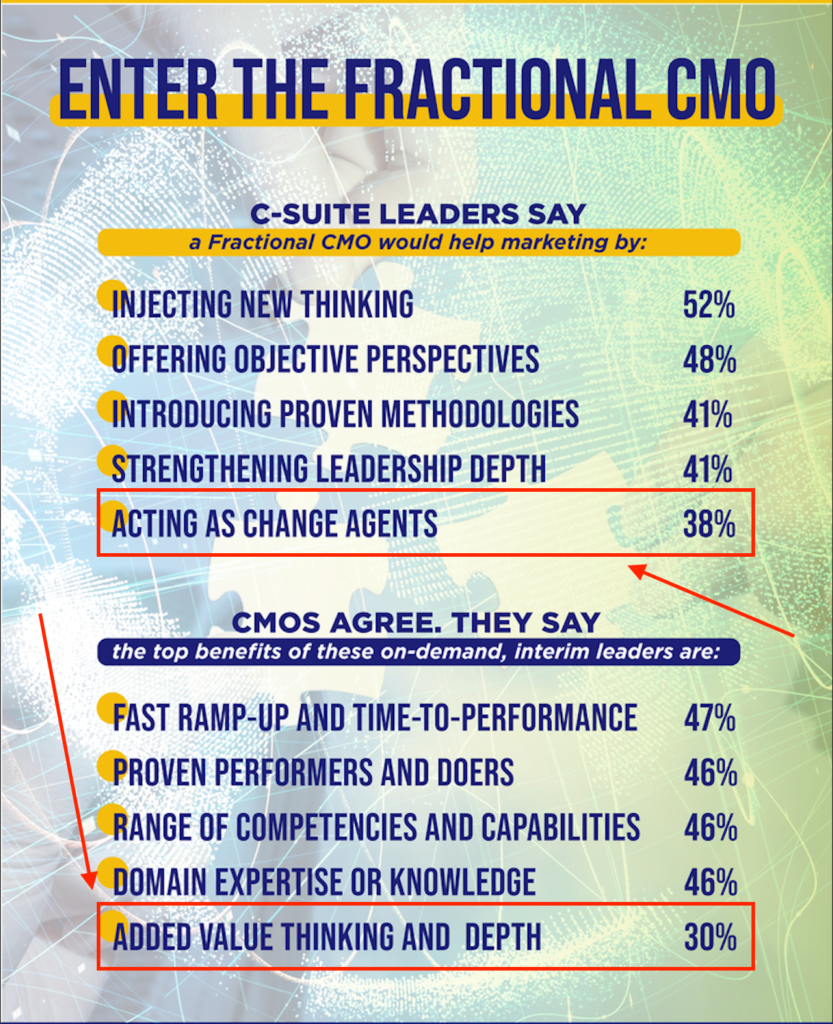
When C-Suite leaders were asked how a Fractional CMO would actually help their marketing, only 38% believed they could act as “Change Agents.” Think about that. If you are hiring a senior leader to fix your growth trajectory, but the majority of executives don’t trust them to actually drive change, what are you paying for?
The data gets even more concerning in the “CMOs Agree” section of the report. When asked to identify the top benefits of these on-demand leaders, the consensus on their core skills was underwhelming. The numbers for critical attributes like “Domain Expertise,” “Range of Competencies,” and “Proven Performers” all fell below 50%.
This effectively confirms that hiring a solitary Fractional CMO is a coin toss. You are betting your Q3 and Q4 revenue on a single individual who, statistically speaking, likely lacks the full range of competencies required to execute a modern digital strategy.
The 5K Difference: Don’t Hire a Person, Hire a Capability
This is where the 5K model diverges from the standard FCMO approach. The reason those “competency” numbers in the infographic are so low is that no single human being can be an expert in brand strategy, technical SEO, paid media, and AI integration all at once.
When you work with a competent digital growth firm like 5K, you aren’t limited by the bandwidth or skill gaps of one person. You leverage the full-house capabilities of a complete team of digital marketers, data architects, and business growth experts. We provide the “Change Agent” status that 62% of CEOs feel is missing — and we often do it for the same cost (or less) than a single, overwhelmed Fractional CMO.
The Difference Between a Brand Manager and a Growth Builder
There’s a fundamental distinction that most CEOs miss when hiring fractional leadership:
Brand Managers focus on perception — how the company looks, feels, and sounds. They care about consistency, awareness, and “share of voice.”
Growth Builders focus on revenue mechanics — how marketing dollars translate into pipeline, customers, and profit. They care about attribution, customer acquisition cost, lifetime value, and contribution margin.
Both roles matter. But if you’re a mid-market company trying to scale from $10M to $20M, you don’t need someone who “manages the brand.” You need someone who can build a predictable revenue engine.
The problem? Most Fractional CMOs are brand managers masquerading as growth builders.
They’ll attend your leadership meetings. They’ll create a beautiful brand guidelines document. They’ll advise you to “invest in content” or “build thought leadership.”
But when it comes to the hard work of building systems that generate measurable, repeatable revenue? They’re out of their depth.

The 5-10 Hour Trap
Here’s another structural problem with the typical FCMO engagement:
Most Fractional CMOs work 5-10 hours per week on your account. That sounds reasonable until you think about what that actually means.
In 5-10 hours, they can:
- Attend a couple of meetings
- Review some reports
- Offer high-level “strategic advice”
What they can’t do in 5-10 hours:
- Deeply understand your operations
- Audit your existing processes for inefficiencies
- Build the systems required for scalable growth
- Actually own outcomes
The result? You’re paying for a “strategist” who gives you advice but doesn’t own the execution. They tell you what to do, but they’re not in the trenches making sure it gets done right. Sometimes, they just muddy the waters.
And when results don’t materialize, it’s typically something like “The agency didn’t execute properly”; The sales team didn’t follow up”; The timing wasn’t right.
The FCMO floats above the chaos, offering perspective but seldom accountability.
The Real Cost: Opportunity and Momentum
The financial cost of a failed FCMO engagement is painful — typically $8K-$15K per month for 6-12 months before you pull the plug. That’s $50K-$180K spent on “strategy” that didn’t move the needle.
But the real cost is harder to quantify: lost time and momentum.
Every month you spend with the wrong marketing leadership is a month your competitors are pulling ahead. It’s a month of misallocated ad spend, unfocused campaigns, and a team that’s busy but not productive.
What Actually Works: Depth Before Strategy
Here’s what we’ve learned after 20+ years of helping businesses grow:
You can’t build effective marketing strategy without first understanding operations.
Most marketing problems aren’t actually marketing problems. They’re operational problems that show up in marketing metrics.
- Your lead quality is poor? That’s often a targeting problem rooted in unclear customer segmentation.
- Appointments are down? Your team isn’t following up with them until a day or two after. The “conversion-to-contact” window is really important and often overlooked.
- Your sales cycle is too long? That’s often a process problem — leads aren’t being nurtured or handed off correctly.
- Your team is overwhelmed but results are flat? That’s an efficiency problem — too much manual work, not enough systems.
A Fractional CMO who parachutes in with “strategy” without understanding these operational realities is building on sand.
How We Approach Fractional Leadership Differently
At 5K, we don’t start with strategy. We start with clarity.
That’s why we developed audit.5k.co
This comprehensive business audit is structured to understand how your business actually operates. Where are the bottlenecks? Where is time being wasted? Where are the hidden inefficiencies that are silently destroying profitability?
This audit is a 2-week deep dive into your operations designed to uncover the hidden inefficiencies costing you real money and build a concrete roadmap to automate them away.
Week 1: Discovery & Analysis
We become inefficiency detectives inside your business. We interview 3-5 key leaders across departments to understand strategic priorities, known bottlenecks, and technology stack. Then we talk to 5-10 end users — the people doing the actual work — to find where time is really being consumed, where manual workarounds have been created, and where errors keep happening.
We map your core processes across three key areas:
- Acquisition Engine (how you attract and close customers)
- Delivery Engine (how you fulfill)
- Support Engine (how you service customers post-sale).
Week 2: Solution Design & Roadmap
We translate problems into prioritized, costed opportunities. Every inefficiency gets evaluated across two dimensions:
- Business Impact
- Implementation Effort
This creates your Opportunity Matrix — showing you:
- Quick Wins (high impact, low effort)
- Big Swings (transformational projects)
- Nice-to-Haves
- What to avoid
For every recommended automation, we calculate the specific financial impact using your real numbers: hours currently spent, employees affected, salary rates, time savings potential, and implementation costs. You walk away with visual process maps, the Opportunity Matrix, detailed ROI analysis for each initiative, a phased 90-day implementation roadmap, and an executive presentation deck.
Most companies discover $100K-$300K in annual efficiency opportunities in just these two weeks — money that’s being lost to manual data entry, repetitive work that should take 30 minutes but takes 3 hours, spreadsheets instead of systems, and processes your team has gotten so used to they don’t even see the problems anymore.
Fractional Leadership That Actually Owns Outcomes
When we provide fractional marketing leadership, it’s built on a foundation of operational understanding — not surface-level “strategy sessions.”
Our approach is different:
We speak both languages. We can talk EBITDA and margin with your CEO and server-side tracking architecture with your marketing team. Nothing gets lost in translation.
We think in systems. We don’t just advise on individual campaigns. We build ProfitPaths™ — distinct, measurable revenue streams that connect specific offerings to specific audiences with their own funnels and attribution.
We hold ourselves accountable to profit, not activity. We measure success by contribution margin and net revenue, not impressions and clicks. If the strategy isn’t working, we own that — and we fix it.
We have the technical depth. Signal loss, server-side tracking, attribution modeling, AI-driven automation — we’re not learning this stuff on your dime. We’ve been implementing it for years.
The Bottom Line
The Fractional CMO model isn’t inherently broken. But the way most companies implement it is.
Hiring a generalist who floats above your business offering “strategic advice” 5 hours a week isn’t going to transform your growth trajectory. It’s going to drain your budget and waste your time.
What actually works is fractional leadership built on deep operational understanding — leadership that knows where the inefficiencies are, where the leverage points are, and how to build systems that compound over time.
If you’re considering fractional marketing leadership, start with clarity first.
Schedule a Growth Strategy Session to learn more about 5K Fractional and how our Business Efficiency Audit can uncover the hidden inefficiencies in your operations — and build the foundation for marketing that actually drives profit.
Coming in Part 2: The FCMO Litmus Test — the specific questions to ask any Fractional CMO candidate to separate the operators from the pretenders.