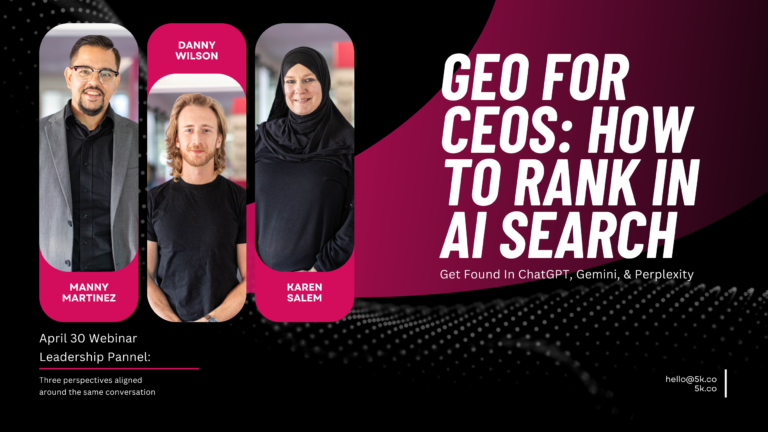
The Shift CEOs Cannot Afford to Ignore
Search behavior is undergoing a fundamental transformation. For years, businesses competed for visibility within traditional search engines, optimizing content to rank in Google’s list of blue links. Today, that model is evolving into something far more dynamic.
Buyers are no longer relying solely on search engines. They are turning to AI platforms like ChatGPT, Gemini, and Perplexity to ask questions, evaluate options, and build shortlists before ever visiting a company’s website.
For CEOs, this represents a critical shift. Visibility is no longer just about ranking on a search results page. It is about being present in the conversations that shape purchasing decisions long before a prospect clicks through.
From Search Engines to Answer Engines
Traditional SEO focused on ranking for keywords. A user would type a phrase, review results, and click through to websites for more information.
AI-driven search changes that experience entirely. Instead of scanning multiple links, users now ask detailed questions and receive synthesized answers. These answers often include recommendations, comparisons, and cited sources, all within a single interface.
This creates what many are calling a “zero-click” environment, where buyers gather information without ever visiting a website.
For leadership teams, the implication is clear. If your business is not being surfaced within these AI-generated responses, you may be excluded from consideration before the buying process even begins.
Understanding GEO, SEO, and AEO
To navigate this new environment, it is important to understand how traditional and emerging strategies fit together.
Search Engine Optimization (SEO) remains foundational. It includes content strategy, technical performance, and authority signals such as backlinks. These elements still influence visibility across both traditional and AI-driven platforms.
Generative Engine Optimization (GEO) builds on this foundation. It focuses on how businesses appear within AI platforms like ChatGPT and Perplexity. The goal is not just ranking, but being cited as a trusted source within generated responses.
Answer Engine Optimization (AEO) sits alongside this, focusing on securing visibility in AI-generated summaries within traditional search engines, such as Google’s AI overview.
Rather than replacing SEO, these approaches expand it. The most effective strategies integrate all three.
How Buyer Behavior Is Changing
One of the most important developments for CEOs to understand is how dramatically buyer behavior has evolved.
Instead of searching for short phrases, users now describe full scenarios. They explain their challenges, constraints, and goals, and expect AI systems to guide them toward solutions.
This conversational approach allows buyers to:
- Explore options more deeply
- Refine their thinking through follow-up questions
- Build a shortlist of vendors before engaging directly
As a result, companies are entering the decision-making process later, but with more informed prospects.
This shift changes the nature of competition. Visibility is no longer about attracting clicks. It is about influencing the research phase that happens before those clicks occur.
Why Visibility in AI Platforms Matters
The scale of this shift is significant. AI platforms are experiencing rapid adoption, with billions of interactions occurring monthly.
At the same time, traditional search traffic is expected to decline as users migrate toward conversational interfaces.
However, there is an important nuance. While overall traffic may decrease, the quality of that traffic is improving. Prospects who arrive at a website after conducting AI-driven research tend to be more informed and closer to making a decision.
For CEOs, this reframes how success should be measured. The focus shifts from volume to relevance and conversion potential.
What Makes a Business Visible in AI Search
Despite the changes in how people search, many foundational principles still apply.
High-quality content remains essential. Businesses must create content that clearly answers questions, addresses pain points, and demonstrates expertise.
Structure also plays a critical role. AI systems favor content that is easy to interpret and extract. This includes:
- Providing direct answers early in the content
- Organizing information into clear sections
- Including well-structured FAQ sections
When content is designed in this way, AI platforms can more easily identify and cite relevant portions.
Authority signals are equally important. Mentions on credible websites, backlinks from relevant sources, and consistent brand presence across the web all contribute to how AI systems evaluate trustworthiness.
The Importance of Scenario-Based Content
A key difference between traditional SEO and AI-driven visibility lies in how content is developed.
Keyword-focused strategies are no longer sufficient on their own. Instead, businesses must think in terms of scenarios and underlying intent.
Rather than optimizing for a phrase like “best software for logistics,” companies should consider the broader context. For example, a decision-maker might be asking how to improve warehouse efficiency or scale operations without expanding physical space.
By identifying these real-world scenarios and creating content that directly addresses them, businesses align more closely with how users interact with AI systems.
This approach allows companies to participate in conversations that reflect actual decision-making processes.
Authority and Trust Still Drive Outcomes
While the technology has evolved, the importance of credibility has not.
AI platforms rely heavily on external validation when determining which sources to surface. This includes references from authoritative websites, industry publications, and credible third-party platforms.
Link building remains a critical component of this process. When other reputable sources reference your business, it signals trust and relevance.
However, quality matters more than quantity. Links must come from relevant, credible sources that align with your industry. Poor-quality links or irrelevant placements can undermine credibility rather than strengthen it.
For CEOs, this reinforces the importance of brand reputation beyond owned channels.
Measuring Visibility in a Changing Landscape
One of the challenges of this new environment is measurement.
Traditional metrics such as keyword rankings and organic traffic do not fully capture how a business is performing within AI platforms.
Organizations must begin tracking:
- Whether their brand is mentioned in AI-generated responses
- How frequently they appear compared to competitors
- The sentiment and context of those mentions
This can be done through structured tracking systems, whether automated platforms or manual processes.
Without this visibility, it is difficult to understand where opportunities exist or how strategies should evolve.
A New Strategic Priority for CEOs
The rise of AI-driven search is not a temporary trend. It represents a structural change in how information is discovered and evaluated.
For CEOs, the priority is not to abandon existing strategies, but to expand them. The businesses that succeed will be those that:
- Adapt their content to match conversational search behavior
- Strengthen their authority across the digital ecosystem
- Focus on solving real customer problems rather than targeting isolated keywords
- Measure visibility beyond traditional metrics
This shift rewards companies that think systemically about how they are discovered, evaluated, and trusted.
The competitive advantage will not come from reacting to change, but from understanding it early and acting with intention.