Blog
April 24, 2026
Zero-Click Search Is Here: How to Win When Users Don’t Click Through
Your organic search traffic is down. Your rankings are holding steady, maybe even improving. Search volume in your category has not declined. And yet, the visitors are not showing up in your analytics the way they used to. If you are a marketing leader looking at this disconnect and wondering what happened, you are experiencing […]
Your organic search traffic is down. Your rankings are holding steady, maybe even improving. Search volume in your category has not declined. And yet, the visitors are not showing up in your analytics the way they used to.
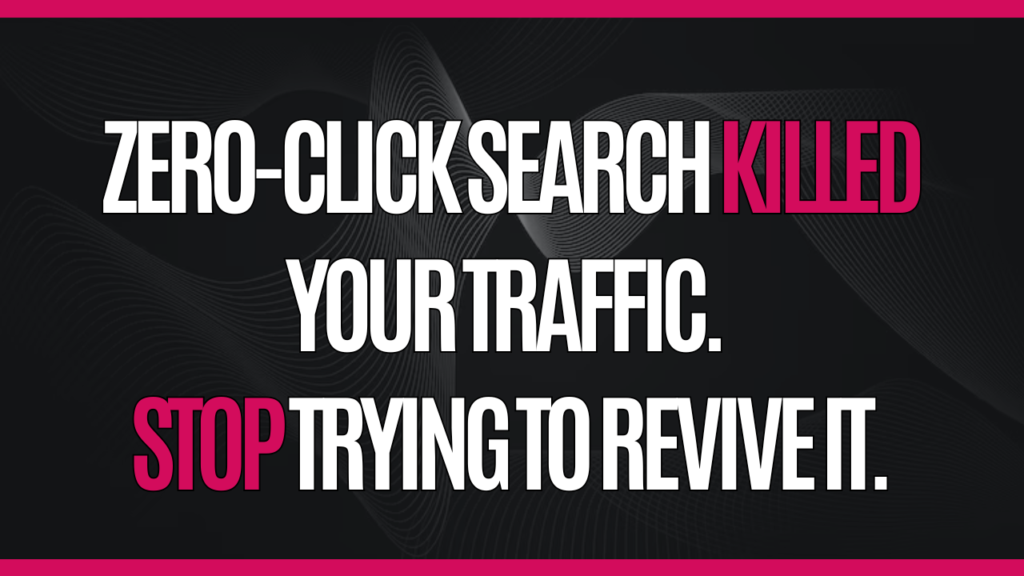
If you are a marketing leader looking at this disconnect and wondering what happened, you are experiencing zero-click search in real time. It is not a temporary algorithm glitch. It is the new structural reality of how search engines deliver answers in 2026, and the businesses still optimizing for click-through rates are measuring success against a standard that no longer applies.
Here is what zero-click search actually is, why it is permanent, and how forward-thinking marketing teams are rebuilding their strategy to win in a world where users get their answers without ever visiting your website.
What Zero-Click Search Actually Means
Zero-click search is the now-dominant pattern where users get the information they need directly from a search engine results page — through AI Overviews, featured snippets, knowledge panels, or direct answer boxes — without clicking through to any website. A 2024 study from SparkToro found that nearly 60% of Google searches ended without a click, and that number has climbed meaningfully since as AI Overviews have expanded to more query types.
For commercial and technical queries specifically, the numbers are even starker. When a procurement manager searches “ISO 9001 certified precision machining suppliers in Michigan,” Google’s AI Overview often synthesizes the answer from multiple vendor websites, displays supplier names and key capabilities directly in the response, and leaves the searcher with the information they needed without ever requiring a click. The websites that provided the underlying data may appear as small citations beneath the AI Overview, but the majority of users get what they need and move on.
This is what we at 5K call The Great Decoupling, the growing gap between search query volume and organic click-through traffic. Search demand is holding steady or growing. Click traffic to websites is declining. The traditional SEO success metric — clicks driven by rankings — is becoming an increasingly incomplete picture of actual search performance.
Why Zero-Click Is Not a Temporary Trend
Every few years, marketing leaders hope that Google will reverse course and restore the click-based traffic model. It is not going to happen, and here is why.
Zero-click search serves Google’s users better than click-through search does for most queries.
When someone asks “what is the tensile strength of grade 5 titanium,” they do not want to click through three vendor websites to find the answer. They want the answer. Google has spent the last three years training users to expect that experience, and user satisfaction metrics with AI Overviews are consistently high. Google is not going to reverse a product decision that measurably improves the core search experience.
The AI search engines competing with Google are doubling down on the same pattern.
ChatGPT, Gemini, and Perplexity all operate on a synthesized-answer model by default. The idea of a search engine that returns ten blue links and sends users away to find their own answers is rapidly becoming the minority user experience, not the default.
The underlying economics favor zero-click for the platforms.
Google monetizes AI Overviews through sponsored placements inside the response itself. The platform captures more of the user’s attention and more of the monetization cycle when the user stays on the results page instead of clicking away. There is no commercial incentive for Google to restore a model that sends users off-platform to competitors’ sites.
The businesses accepting this reality are the ones winning right now. The businesses waiting for click traffic to return are watching their organic performance decline quarter over quarter and wondering why nothing they try seems to fix it.
What “Winning” Looks Like in a Zero-Click World
If clicks are declining and rankings alone no longer predict business outcomes, what does marketing success actually look like in 2026? It comes down to three new metrics that matter more than click-through rate.
Citation frequency measures how often your brand is mentioned in AI Overviews, ChatGPT responses, Gemini answers, and Perplexity citations for queries relevant to your category. This is the new “ranking” that matters, because being cited in a zero-click response is what puts your brand in front of the user even when they do not visit your site. We covered the full measurement framework for this in our recent article on How to Measure and Improve Your Brand’s Visibility in ChatGPT, Gemini, and Perplexity.
Competitive share of voice measures your citation frequency relative to your direct competitors across your category’s query landscape. If ChatGPT cites you in 30% of relevant responses and your closest competitor is cited in 45%, you have a measurable competitive gap that would be invisible in traditional SEO reporting.
Brand presence without click attribution measures the downstream impact of being present in AI-mediated research even when no click occurs. This shows up as direct traffic increases (users who see your brand in an AI response and type your URL later), branded search volume growth (users who hear your name mentioned and search for you specifically), and inbound lead quality improvements (leads arriving with stronger pre-formed opinions about your brand).
None of these metrics show up in Google Analytics or traditional SEO tools. Measuring them requires tools like 5K Analytics, which tracks SERP positioning and AI citation visibility in a unified dashboard, giving marketing teams the ability to see their brand’s presence across both traditional search and the zero-click environments where the majority of user interactions now happen.
The Three Strategic Shifts That Separate Winners from Losers
Marketing teams successfully adapting to zero-click search share three common strategic shifts in how they approach content, measurement, and success metrics.
The businesses making these shifts are rebuilding their content strategy around what we call Answer Nugget Density, the GEO metric measuring how many self-contained, citable answer statements exist per 1,000 words of content. 5K targets a minimum of six answer nuggets per 1,000 words across all GEO-optimized content, because that density is what makes content consistently extractable and citable by AI search platforms.
What to Actually Do About This
If you are responsible for marketing performance and your organic traffic is declining despite steady or growing search demand in your category, here are the concrete actions that produce results within 90 days.
Audit your existing high-value content for extractability. Look at the pages that historically drove the most organic traffic. Are they structured with clear H2 and H3 hierarchy? Do they include FAQ sections with concise one-to-three sentence answers? Do they have schema markup implemented? If not, these are your fastest wins. Restructuring existing ranking content for extractability often produces measurable citation gains within 60 days without creating a single new piece of content.
Implement unified measurement that tracks AI visibility alongside traditional SEO metrics. Without visibility into how you perform across both Google’s traditional index and AI search platforms, you are making content decisions on a fraction of the data you actually need. This is the specific gap that 5K Analytics was built to close, and it is the measurement foundation every other strategic decision depends on.
Shift the conversation with leadership. Marketing leaders reporting to executives in 2026 need to stop defending flat or declining organic traffic numbers and start reporting on new metrics. Citation frequency growth, share of voice trends, and brand presence indicators give leadership a clearer picture of what is actually happening than traffic numbers that have become structurally unreliable. We wrote about this measurement shift in depth in our recent article on The Dark Funnel Playbook: How B2B Buyers Research in AI Before They Ever Visit Your Website.
Build a Topical Moat around your highest-value category. Scattered content across multiple topics produces weak citation authority everywhere. Concentrated content around a specific category produces strong citation authority in the one place that matters most. This is where the principles we covered in our GEO for Manufacturing guide apply to any business with a defined ideal customer or core service offering.
Watch Our 5K Five: GEO Is Eating Search. Here’s What That Means for Your Traffic. 👇
The Opportunity Inside the Disruption
Here is the counterintuitive truth about zero-click search. The marketing leaders treating it as a crisis are the ones who will lose. The marketing leaders treating it as a strategic opening are the ones who will win.
Zero-click search concentrates visibility. Instead of being one of ten blue links a searcher might or might not click, the cited sources in an AI Overview get the entire spotlight for that query. The brands that earn those citations consistently become the recognized authorities in their categories. The brands that do not earn citations become functionally invisible regardless of their traditional SEO rankings.
This concentration is actually a larger opportunity than the click-through search it replaces. In the click-through model, ranking number one typically earned about 30% of the clicks, and ranks two through ten split the rest. In the zero-click model, earning citation authority in your category means your brand is functionally the answer whenever buyers research in AI search. That is a much more powerful position than even a top organic ranking used to provide.
The businesses still waiting for the old search model to return are ceding that opportunity quarter by quarter. The businesses investing in citation authority, extractable content, and AI visibility measurement are building a structural advantage that will compound over the next three to five years as AI search becomes the primary discovery channel across more categories.
Zero-click search is not the end of organic marketing. It is the beginning of a new version of it, one where the brands that adapt first build durable advantages and the brands that resist spend the next decade wondering what happened to their traffic. Deciding which of those two outcomes applies to your business is a choice you are making right now, whether you realize it or not.
5K Team
Our team helps companies to increase revenue, decrease costs, increase efficiency, and scale employees using digital marketing and AI technology.
Tags
Ready to Grow Your Business?
SCHEDULE A GROWTH STRATEGY SESSIONMost Recent Articles

The PPC Audit Most Companies Never Get: What a Real One Includes and How Long It Should Take
October 7, 2026
Read More

Two Agencies, One Sale: How to Split SEO and PPC Without Paying Twice for the Same Customer
October 7, 2026
Read More

5 Questions to Ask Your PPC Agency: How to Tell a Real Answer From a Polished Dodge
October 7, 2026
Read More