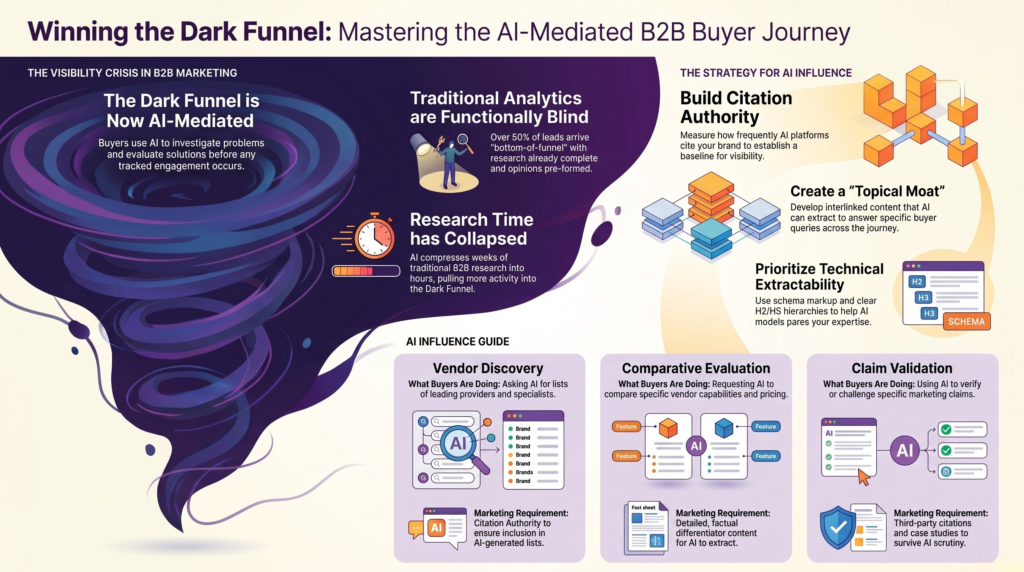
The Dark Funnel is the invisible research phase where B2B buyers use conversational AI tools like ChatGPT, Gemini, Perplexity, and Copilot to investigate problems, evaluate solutions, and shortlist vendors before ever visiting a company’s website.
This phase is invisible to traditional analytics because no click, form submission, or pageview occurs until after the buyer has already formed strong opinions. For demand generation teams, the Dark Funnel represents both the largest blind spot in their measurement infrastructure and the highest-leverage opportunity to influence buyer decisions in 2026. 5K’s approach to Dark Funnel marketing combines GEO content strategy with Citation Authority measurement through 5K Analytics to make the invisible visible.
THE CEO TAKEAWAY: By the time a B2B buyer fills out your contact form, they have already done most of their research, and most of that research now happens inside AI tools you have no visibility into. If your brand is not being cited by ChatGPT, Gemini, and Perplexity during that research phase, you are not in the consideration set when buyers reach out, and the leads that do come through are increasingly the ones your competitors did not want. The Dark Funnel is where modern B2B buying decisions are being made. Your marketing program either influences it or it does not.
Yeah, That Sort Of Sales Call…
A sales director at an industrial automation company hopped on what he expected to be an early-stage discovery call with a prospect from a Fortune 500 food manufacturer. The lead had come through the company’s website contact form three days earlier with a brief note about exploring options for a packaging line upgrade. Pretty typical.
Standard discovery script. Build rapport, qualify needs, identify pain points, schedule a follow-up technical conversation. He had done (literally) thousands of these calls.
The prospect joined the video call already prepared. Within the first five minutes, she said something that stopped him in his tracks.
“I’ve already narrowed it down to your company and two others. I’ve reviewed your case studies on the dairy and beverage projects, I know about your ISO 13485 certification work, and I’ve seen the comparison between your servo-driven systems and the competitors. I’d like to skip the introductory material and get into a technical conversation about implementation timelines and integration with our existing Siemens infrastructure.”
He had never spoken with this person before.
She had never downloaded a piece of his content.
She was not in his marketing automation system as a tracked contact.
The first time anyone at his company had any record of her existence was when she filled out the contact form three days earlier, already at the bottom of her funnel, ready to talk implementation.
After the call, he asked her how she had done her research. Her answer: ChatGPT and Perplexity, primarily. She had spent about six weeks asking AI tools detailed questions about packaging automation vendors, comparing capabilities, validating claims, and building a shortlist. By the time she filled out his contact form, the research was effectively complete.
Welcome to the new world.
He went back to his marketing team and asked them how many leads in the past quarter had described a similar journey. The answer surprised everyone: more than half. The marketing team had no visibility into any of it. Their reports showed lead source as “Direct” or “Organic Search,” but the actual buyer journey had taken place entirely inside AI platforms their analytics could not see.
This is the Dark Funnel. And in 2026, it is no longer an emerging trend. It is (becoming) the dominant pattern of B2B buying behavior, and most marketing teams are operating as if it does not exist.
What the Dark Funnel Actually Is
The Dark Funnel is not a new concept in B2B marketing, but its mechanics have changed dramatically with the rise of conversational AI. Originally, the term referred to the invisible word-of-mouth, peer review, and community research that buyers did before ever appearing in a vendor’s CRM.
We’re talking things like Slack channels, LinkedIn DMs, peer Slack groups, G2 review pages, podcast recommendations.
All real, all influential, all invisible to traditional analytics.
The 2026 version of the Dark Funnel includes all of those traditional channels plus a much larger and more measurable layer: AI-mediated research. The Dark Funnel today is the entire buyer journey that occurs through AI search tools, peer networks, third-party platforms, and dark social channels before a buyer ever generates a tracked engagement with the vendor. It encompasses the questions buyers ask ChatGPT about their problems, the comparisons they request from Perplexity, the vendor lists they generate from Gemini, and the validation they seek from Copilot, all before a single pageview shows up in your analytics.
The shift matters because the AI-mediated layer is now the largest portion of the Dark Funnel for most B2B categories. While peer recommendations and review sites still play a role, the speed, scale, and convenience of AI research has made it the default starting point for most buyers under 50 in technical and professional purchase categories. And unlike peer conversations, AI research happens at a measurable scale and with measurable patterns, even though most marketing teams have not yet built the infrastructure to see it.
Why the Dark Funnel Has Exploded in 2026
Three forces have converged to make AI-mediated research the dominant pattern in B2B buying in 2026.
AI tools have become genuinely useful for vendor research
The first generation of consumer AI tools were impressive at general knowledge but unreliable for specific business research. Buyers who tried using ChatGPT to research vendors in 2023 often got hallucinated company names, outdated information, or generic answers that did not help with real evaluation. By 2026, the major AI platforms have improved their accuracy, source attribution, and depth of category-specific knowledge to the point where they are genuinely better for early-stage vendor research than traditional Google search for many use cases.
Buyer behavior has caught up to tool capability
Younger procurement professionals and demand-side decision-makers have integrated AI tools into their daily research workflow the same way previous generations integrated Google. For a 35-year-old plant engineer evaluating new automation suppliers, opening ChatGPT is faster, more conversational, and more useful than running multiple Google searches and clicking through ten different vendor websites. This generational shift is now showing up at the senior buying-committee level as the AI-native generation moves into more decision-making roles.
The cost of buyer research has collapsed
Traditional B2B research required significant time investment: reading whitepapers, attending webinars, scheduling sales calls, navigating vendor websites. AI tools compress that research into minutes instead of weeks. A buyer can now generate a comprehensive vendor comparison, validate claims against multiple sources, and build a qualified shortlist in a single afternoon. The economics of buyer research have fundamentally changed, and that change pulls more of the buying journey into the Dark Funnel by definition.
The cumulative effect is that B2B buyers in 2026 are arriving at vendor websites later in their journey, with stronger pre-formed opinions, and with shortlists that have already excluded vendors who were not visible during the AI-mediated research phase. The vendors that win the Dark Funnel win the deals. The vendors that do not are increasingly competing for second-place finishes in opportunities they did not know they were already in.
The Five Dark Funnel Behaviors Every Marketing Team Should Understand
To influence the Dark Funnel, you have to understand what buyers are actually doing inside AI tools. 5K’s research with B2B buyers across manufacturing, professional services, and high-ticket DTC has identified five distinct behaviors that define the modern Dark Funnel research journey.
| Dark Funnel Behavior | What Buyers Are Doing | What It Means for Marketing |
|---|---|---|
| Problem Definition Queries | Asking AI to help articulate, refine, or scope the actual problem they are trying to solve before identifying solution categories | Educational content that defines problems precisely is highly extractable and earns citations at the earliest stage of the funnel |
| Solution Category Exploration | Asking AI to explain what types of solutions exist, how they differ, and which categories fit their specific situation | Comparison and category-explanation content positions your brand as an expert voice across the broader category, not just as a vendor |
| Vendor Discovery and Listing | Asking AI to generate lists of leading providers, often with specific qualifying criteria like certifications, geography, or specialization | Citation Authority directly determines whether your brand appears in these vendor lists; this is the highest-stakes Dark Funnel moment |
| Comparative Evaluation | Asking AI to compare specific vendors against each other across capabilities, pricing models, certifications, and customer fit | Detailed, factual content about your specific differentiators and credentials feeds the comparison narrative AI generates |
| Claim Validation | Asking AI to verify or challenge specific claims a vendor has made (often after visiting the vendor website or talking to sales) | Third-party citations, case studies, and verifiable proof points become critical for surviving validation queries |
Each of these five behaviors represents a moment where your brand can be present or absent in the buyer’s research, and each requires a different content strategy to influence effectively. A vendor that wins Solution Category Exploration but loses Vendor Discovery and Listing will be educated about by AI but never recommended. A vendor that appears in vendor lists but loses Comparative Evaluation will make the shortlist but lose the deal. The Dark Funnel rewards comprehensive presence, not narrow optimization.
Why Your Current Analytics Cannot See Any of This
The fundamental measurement problem with the Dark Funnel is that none of these AI-mediated research moments produce a tracked engagement until the very end of the journey, if they produce one at all. Your existing analytics infrastructure is functionally blind to the most influential portion of the modern B2B buyer journey.
Google Analytics tells you that traffic is “Direct” when a buyer types your URL after seeing your name in an AI response, even though that buyer would never have known your URL without the AI mention. HubSpot or Marketo records the lead as having converted on a specific landing page, with no visibility into the six weeks of AI research that preceded the visit. Attribution models built on click-stream data assume the journey starts when the first tracked touchpoint occurs, which is now often the moment the buyer is ready to talk to sales.
The result is a measurement system that systematically undervalues the channels and content that influence the Dark Funnel and overvalues the bottom-of-funnel touchpoints that capture demand the Dark Funnel created. Marketing teams report success based on tracked conversions while remaining blind to whether their brand is even present in the research phase that determines which vendors get those conversions in the first place.
Closing this measurement gap requires a different category of tooling. 5K Analytics is 5K’s proprietary dashboard that tracks SERP positioning and AI citation visibility in a unified view, giving demand generation teams visibility into how their brand appears across both traditional Google search and the AI platforms where Dark Funnel research happens. Without measurement infrastructure designed specifically for AI search visibility, marketing teams are guessing about their performance in the channel that increasingly determines their pipeline outcomes.
How to Influence the Dark Funnel: The Four-Part Playbook
Building a marketing program that influences the Dark Funnel requires four interconnected investments. None of them work in isolation, but together they create the citation authority and content infrastructure that makes your brand present and persuasive across all five Dark Funnel behaviors.
Part 1: Build a Citation Authority Baseline
Before you can improve your Dark Funnel presence, you have to know where you stand. A Citation Authority Audit measures how frequently and favorably AI platforms cite your brand across category-relevant queries, producing the baseline that makes everything else measurable. We covered the full audit methodology in our recent article on how to measure and improve brand visibility in AI search platforms.
Without this baseline, every subsequent investment in Dark Funnel marketing is operating without a measurement foundation. With it, you can track the specific impact of content investments, optimization work, and strategic shifts on your actual citation performance over time.
Part 2: Create GEO-Optimized Content Across All Five Dark Funnel Behaviors
Each of the five Dark Funnel behaviors requires a different type of content to influence effectively. A comprehensive Dark Funnel content strategy covers all five.
- Problem Definition content includes deep articles, frameworks, and diagnostic resources that help buyers articulate problems precisely. This content earns early-stage citations because it provides the conceptual scaffolding AI platforms use to explain problems to users.
- Solution Category content includes category-explanation pieces, “what is X” articles, and educational resources that establish your brand as an authoritative voice on the entire category, not just on your specific offering. This content is what gets cited when buyers ask AI to explain solution categories.
- Vendor Discovery content includes the credentials, capabilities, and differentiators that make your brand an obvious answer when buyers ask for vendor recommendations. This is where structured data, schema markup, certifications, and comprehensive capability pages do their work.
- Comparative Evaluation content includes detailed comparison pages, capability deep-dives, and head-to-head differentiator content. This is where your specific advantages get translated into citable, extractable answer statements.
- Claim Validation content includes case studies, third-party verifications, customer proof points, and detailed evidence backing every meaningful claim. AI platforms are increasingly skeptical and source-aware, and validation content provides the supporting evidence that makes your claims survive scrutiny.
This is the kind of comprehensive content architecture that requires what 5K calls a Topical Moat: a defensible content position built through interlinked, comprehensive coverage of a subject cluster. Building topical moats is the core methodology behind 5K’s GEO and SEO services.
Part 3: Implement Schema Markup and Technical Extractability
Even great content can fail to influence the Dark Funnel if AI platforms cannot efficiently extract and parse it. Schema markup, structured data, clear H2/H3 hierarchy, high Answer Nugget Density, and accessible HTML rendering are all prerequisites for citation. Content locked in PDFs, buried in JavaScript-rendered pages, or written in dense prose without structured answer statements will be functionally invisible to AI platforms regardless of its quality.
The technical extractability layer is often where 5K Citation Authority Audits identify the highest-leverage improvements for clients. A page with excellent content but poor structural extractability can often be transformed into a high-citation asset with restructuring work alone, without changing the underlying expertise or messaging.
Part 4: Measure, Iterate, and Compound
Dark Funnel marketing is not a one-time campaign. It is a sustained investment in citation authority that compounds over time as AI platforms develop reinforcing patterns around established sources.
Monthly or quarterly re-measurement using 5K Analytics tracks Citation Frequency, Competitive Share of Voice, and Query Coverage trends, giving marketing teams clear data on which investments are paying off and which need adjustment. This is the feedback loop that turns Dark Funnel marketing from a faith-based exercise into a data-driven discipline. It is also the foundation of 5K’s RAMP!™ strategic roadmap, which sequences GEO content investments and measurement cycles to produce compounding citation authority over a 12-to-18-month horizon.
GEO Is Eating Search. Here’s What You Can Do About It 👇
What Changes for Marketing Teams That Take the Dark Funnel Seriously
Marketing teams that invest seriously in Dark Funnel marketing experience three significant shifts in how their function operates and how they are evaluated.
The conversation with sales changes. When marketing can demonstrate that the brand is being cited in AI research across the buyer journey, sales teams stop dismissing late-stage inbound leads as having come from nowhere. The recognition that those leads are actually the visible portion of a much larger Dark Funnel investment shifts the credit dynamic between marketing and sales in a way that benefits both functions.
The content strategy gets sharper. Once marketing teams have visibility into which content is earning citations and which is not, the content production process becomes dramatically more focused. Resources stop getting spent on content that nobody reads and nothing cites, and start getting invested in the specific content types that influence Dark Funnel research moments.
The CFO conversation gets easier. Marketing budgets justified by tracked clicks and form fills become harder to defend as the Dark Funnel grows. Marketing budgets justified by Citation Authority growth, Competitive Share of Voice gains, and measurable AI visibility improvements give CFOs and CEOs the kind of progress data they need to feel confident about continued investment, even when traditional traffic and conversion metrics are flat or declining.
This is what it looks like when a marketing team treats the Dark Funnel as a measurable, addressable opportunity rather than an invisible mystery. The brands building this capability now will have a significant advantage over those still measuring success exclusively through tracked engagement metrics, because the Dark Funnel only grows from here.
Frequently Asked Questions
What is the Dark Funnel?
The Dark Funnel is the invisible research phase where B2B buyers use AI tools like ChatGPT, Gemini, and Perplexity, along with peer networks and third-party platforms, to investigate problems and evaluate vendors before ever generating a tracked engagement with a company. In 2026, the AI-mediated portion of the Dark Funnel has become the largest and most influential layer of the B2B buyer journey for most categories.
How is the Dark Funnel different from traditional buyer research?
Traditional buyer research happened largely on vendor websites, generating tracked pageviews, content downloads, and form submissions that marketing teams could see in their analytics. Dark Funnel research happens primarily in AI tools, peer networks, and third-party platforms where vendors have no visibility, meaning buyers form strong opinions and shortlist vendors before any tracked engagement occurs.
Why can’t traditional analytics measure the Dark Funnel?
Tools like Google Analytics, HubSpot, and SEMrush were built to measure tracked engagement on owned properties. The Dark Funnel happens entirely off your owned properties, in AI platforms and third-party channels that produce no clicks or conversions until after the buyer is ready to engage directly. Measuring the Dark Funnel requires dedicated tools like 5K Analytics that track AI citation visibility specifically.
What is a Citation Authority Audit, and how does it relate to the Dark Funnel?
A Citation Authority Audit measures how frequently and favorably AI search engines cite your brand across category-relevant queries. Because the Dark Funnel is largely AI-mediated, citation authority is the most direct measurable proxy for your brand’s presence and influence in the Dark Funnel. Without citation authority, your brand is functionally invisible during the most influential portion of the modern B2B buyer journey.
How long does it take to influence the Dark Funnel?
Most B2B brands working with 5K see measurable improvements in AI citation visibility within 60 to 90 days of implementing Dark Funnel content and optimization strategies. Meaningful shifts in Competitive Share of Voice within a category typically require 4 to 6 months of sustained investment. The compounding nature of citation authority means early investments produce accelerating returns over a 12-to-18-month horizon.
What types of content are most effective for Dark Funnel influence?
Effective Dark Funnel content covers all five Dark Funnel behaviors: Problem Definition, Solution Category Exploration, Vendor Discovery, Comparative Evaluation, and Claim Validation. Each behavior requires a different content type, and brands that build comprehensive coverage across all five (what 5K calls a Topical Moat) consistently outperform brands that focus narrowly on one or two.