I was on a call last week with a CEO whose company did $12M last year. By most standards, that’s a success story. Solid growth trajectory, healthy team, a respectable and growing presence in the market.
Fifteen Minutes Into The Conversation…
I asked a question I always ask at some point: “Of your service lines, which ones are actually driving your profitability?”
There was a pause. Not the brief “let me think” pause, but the longer, more “I’m unsure” kind.
“Well… they all contribute to the overall picture,” he said, choosing his words carefully. “We look at the total revenue and the business as a whole, and we’re growing year over year.”
I nodded. “I appreciate that. But here’s what I’m really asking: If you had to make a difficult decision tomorrow—keep only three of your core offerings and get rid of the rest—which three would you keep? Which ones would you bet the future of your company on?”
Another way to put it: “Which one of your core products or services stands the chance of putting the most amount of money in your bank account as soon as possible?”
Another pause. This one even longer.
“That’s… that’s a great question,” he said slowly. “I’d honestly need to pull some reports. Our marketing spend is pretty blended across all the offerings, so I’m not sure we have a clean view of that right now.”
No Shame, Just Guidance
This isn’t a criticism of this particular CEO. He’s sharp, experienced, and genuinely committed to growing his company. But this type of conversation happens a few times per month.
A CEO who knows their top-line revenue. Knows their total marketing spend. Can tell you the growth rate year over year. But cannot tell you which specific products or services are actually profitable versus which ones are quietly bleeding the company dry.
They’re marketing “the brand.” Running campaigns that showcase all their capabilities. Celebrating “brand awareness” gains and overall growth metrics. And inadvertently hiding from the granular financial reality that determines whether they’re building wealth or just creating activity.
Here’s the truth we’ve come to understand after working with dozens of mid-market companies: If you’re marketing your business as one monolithic brand, you’re likely obscuring the numbers that matter most. You’re creating a blended picture where your most profitable offerings subsidize underperformers, where your biggest opportunities are starved of resources, and where you simply cannot see what’s actually working.
This is exactly why the ProfitPaths® methodology exists. It brings clarity to the chaos, stops the financial bleeding you didn’t know was happening, and starts building predictable, scalable revenue streams you can actually measure and control.
It’s here to help frustrated CEOs successfully grow their business with more peace of mind.
Let’s get into it.
Does the story above sound like you? If so, we’re here to help. We’ve grown businesses from 0 to 8-9 figures, and we help companies scale past their threshold by bringing clarity and laser-focused business growth strategies.
The Blended Metrics Trap: Why “Overall ROAS” is Lying to You
Let’s say you run a company that offers three services:
- Service A: High-margin consulting ($10K average sale, 60% margin)
- Service B: Mid-tier implementation ($5K average sale, 30% margin)
- Service C: Low-margin maintenance contracts ($500/month, 15% margin)
You’re spending $20K/month on marketing “the company.” All three services are mentioned on the homepage, in your ads, in your content. Your agency reports a “blended ROAS” of 3.5. Sounds decent.
But here’s what’s actually happening beneath the surface:
Service A is generating $50K in revenue from $8K in attributed ad spend. That’s a 6.25 ROAS with a 60% margin — meaning every dollar in ads is returning $3.75 in profit. This is a money printer. Put those dollars in and get more dollars out.
Service B is generating $25K from $7K in ad spend. That’s a 3.57 ROAS with a 30% margin — meaning you’re making about $1.07 profit per dollar spent. Acceptable, but not great.
Service C is generating $10K from $5K in ad spend. That’s a 2.0 ROAS with a 15% margin — meaning you’re losing money. The cost of acquisition exceeds the first-year profit.
Your “blended ROAS” of 3.5 looks fine in the board deck. But Service A is subsidizing Service C’s losses, and you’re spending 25% of your marketing budget on a service that’s actively destroying capital.
This is the blended metrics trap. When you market “the brand,” you cannot isolate which revenue streams are actually profitable. You’re flying blind, making budget allocation decisions based on averages that hide the extremes.
And here’s what makes it worse: most agencies prefer blended reporting. It’s easier to defend. When everything is mixed together, there’s no accountability for specific outcomes. They can point to “overall growth” while the profitable products are starved and the losers are overfunded.
The ProfitPaths® Solution: Isolated Revenue Streams
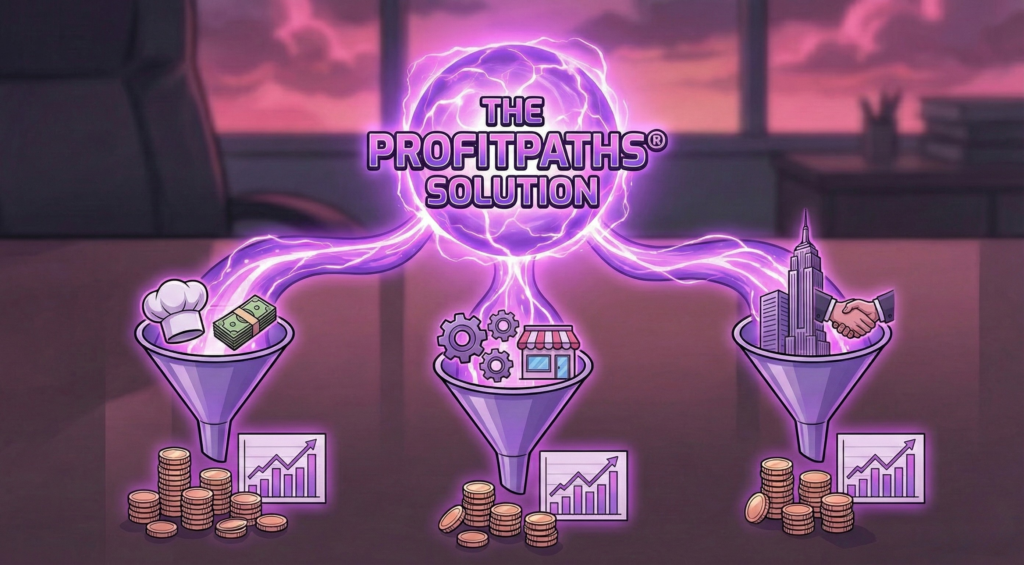
The ProfitPaths® methodology solves this by breaking your business into distinct, measurable paths, each connecting a specific high-margin offering to a hyper-specific audience with dedicated campaigns, funnels, and tracking.
Instead of marketing “the company,” you build separate paths:
- ProfitPath A: Service A → Consulting for Restaurant Owners with $1M+ Revenue
- ProfitPath B: Service B → Implementation for Multi-Location Retail
- ProfitPath C: Service C → Maintenance Contracts for Enterprise Clients
Each path operates as its own isolated P&L for marketing purposes. Separate ad campaigns. Separate landing pages. Separate tracking. Separate reporting.
Now, instead of a blended mess, you can see exactly what’s working:
| Path | Ad Spend | Revenue | Margin | Net Profit | ROI |
| Path A | $8,000 | $50,000 | 60% | $22,000 | 2.75x |
| Path B | $7,000 | $25,000 | 30% | $500 | 0.07x |
| Path C | $5,000 | $10,000 | 15% | -$3,500 | -0.70x |
Suddenly, the decision becomes obvious. Kill Path C. Double down on Path A. Fix or cut Path B.
This is the power of isolation. When you can see the actual unit economics of each revenue stream, you stop wasting money on “brand building” that doesn’t build profit.
Learn about our ProfitPath® approach and why our clients say things like this about us time and again:
“5K created explosive growth for us. They really strive to understand our growth goals and have for 5+ years.” – Steve, Bulk Memory Cards
How to Build Your First ProfitPath® (The IMPACT Framework)
The ProfitPaths® methodology starts with identifying your IMPACT Offering. This is the product or service that deserves focused marketing investment. Not all offerings are created equal, and trying to market everything at once is a recipe for mediocrity.
Use the IMPACT acronym to evaluate your portfolio:
I – Interest: Which offering generates the most genuine interest from prospects? What do people actually ask about?
M – Margin: What’s your highest-margin offering? The one where the gap between cost and price is widest?
P – Potential: Which offering has extraordinary growth potential if you increased volume? What’s currently underutilized?
A – Attract: What offering most effortlessly attracts new customers and referrals? What sells itself once people know about it?
C – Competition: Which offering faces the least competition and market noise? Where can you own a category?
T – Tenure: What offering creates long-term, repeat business? What increases customer lifetime value through extended relationships?
Let’s use a real example. Imagine you run an IT services company offering:
- Managed IT services (ongoing contracts)
- Cybersecurity audits (one-time projects)
- Cloud migration (one-time projects)
- Hardware sales (transactional)
Running through IMPACT:
- Highest margin? Cybersecurity audits (70% margin)
- Longest tenure? Managed IT services (3+ year average relationships)
- Least competition? Cybersecurity for dental practices (underserved niche)
- Most referrals? Managed IT (clients recommend you when contracts are smooth)
The smart move? Create a ProfitPath® around Managed IT Services for Dental Practices, leading with a Free Cybersecurity Audit as the entry offer (we call that the Prospect Magnet).
This hits multiple IMPACT criteria: high interest (dentists are terrified of HIPAA violations), solid margin on the audit, long-term tenure on managed services, and low competition in the niche.
Step Two: Identify Your IMPACT Customer
Once you’ve selected your offering, you need to define your IMPACT Customer with the same precision. Hyper-specificity is the key to relevance, and relevance is what cuts through the noise.
Most companies market to “small business owners” or “mid-market companies.” That’s too broad. You’re competing with everyone for attention.
The ProfitPaths® approach narrows it aggressively:
- Not “restaurants,” but “full-service restaurants with $1-3M in annual revenue in the Midwest.”
- Not “manufacturers,” but “food manufacturing plants with 50-200 employees looking to upgrade equipment.”
- Not “homebuyers,” but “first-time buyers in their late 20s in rising real estate markets.”
This specificity allows you to craft messaging that feels personal, relevant, and urgent. When a dental practice owner sees an ad that says, “Dental Practices: Are You HIPAA Compliant?”—they stop scrolling. That’s for them.
When they see “Small Businesses: Improve Your Cybersecurity”—they keep scrolling. That’s for everyone, which means it’s for no one.
Use the IMPACT acronym again to identify your ideal customer:
- Interest: Who shows the most enthusiasm for your offering?
- Margin: Which customer segment provides the highest profit?
- Potential: Which group could grow significantly if targeted properly?
- Attract: Who can be effortlessly attracted and likely to refer others?
- Competition: Which segment is underserved by competitors?
- Tenure: Who stays loyal and purchases repeatedly?
Step Three: Build Dedicated Campaigns and Funnels
Here’s where most companies fail: they identify the right offering and the right audience, then send all the traffic to the homepage.
This is marketing malpractice.
Each ProfitPath® requires its own dedicated infrastructure:
Dedicated Landing Pages: A dental practice owner clicking an ad about HIPAA compliance should land on a page that only talks about HIPAA compliance for dental practices. Not your full service list. Not your company history. Just the one thing they care about.
Dedicated Ad Campaigns: Separate ad sets with messaging tailored to the specific audience. Different creative. Different copy. Different offers.
Dedicated Email Sequences: Once someone opts in, they should receive emails specific to their path. A dental practice owner should get emails about HIPAA, patient data security, and compliance deadlines—not generic “cybersecurity tips.”
Dedicated Tracking: Each path needs its own UTM parameters, conversion goals, and attribution model. You cannot blend this traffic with your other campaigns.
This level of isolation is what allows you to measure, optimize, and scale with confidence.
Not sure if you need to focus on how you rank in Google, running paid ads, or both? Do you know how AI can slash inefficiencies and save your company time and money so you can focus on actually moving the needle? We’ll help you figure that out.
The Math That Changes Everything
Once you’ve isolated your ProfitPaths®, you unlock predictable revenue modeling.
Let’s say ProfitPath® A has stabilized:
- Ad Spend: $8,000/month
- Leads Generated: 40 qualified leads
- Close Rate: 25%
- Average Sale: $10,000
- Revenue: $100,000/month
- Net Profit (after COGS, ad spend, agency fees): $30,000/month
Now you can ask the only question that matters: “Can I afford to double this?”
If you double ad spend to $16K and maintain performance, you’re generating $60K/month in profit from this single path. That’s $720K annually from one isolated revenue stream.
This is the difference between “brand marketing” and revenue architecture. Brand marketing is a hope. ProfitPaths® are math.
Listen to our 5k Five episode on why most businesses miss the mark with paid ads (and how the ProfitPath® methodology helps you get dialed in):
Check out the full blog here.
Start With One Path, Then Scale
You don’t need to rebuild your entire marketing operation overnight. Start with one ProfitPath®:
- Identify your highest IMPACT offering using the framework above
- Define your most profitable IMPACT customer with hyper-specific targeting
- Build one dedicated campaign and funnel separate from everything else
- Track it religiously for 90 days
- Kill it or scale it based on actual profitability, not vanity metrics
If it works, you’ve just built a predictable revenue engine. Build a second path. Then a third.
If it doesn’t work, you’ve learned exactly what doesn’t work, without contaminating your entire marketing operation.
The Bottom Line
Marketing “the brand” feels safe. It feels comprehensive. It feels like you’re covering all your bases.
But it’s a financial blindfold. You’re subsidizing losers with winners, starving your best opportunities, and making budget decisions based on blended averages that hide the truth.
The ProfitPaths® methodology forces clarity. It exposes which products actually make money. It allows you to allocate budget based on unit economics, not gut feel. And it creates predictable, scalable revenue streams that you can measure and control.
Stop marketing the company. Start building paths to profit.
Ready to isolate your revenue streams and stop subsidizing losers? At 5K, we help CEOs build ProfitPaths® that turn marketing from a cost center into a profit engine. Schedule a Growth Strategy Session and let’s identify your first high-margin path.