
June 12, 2026
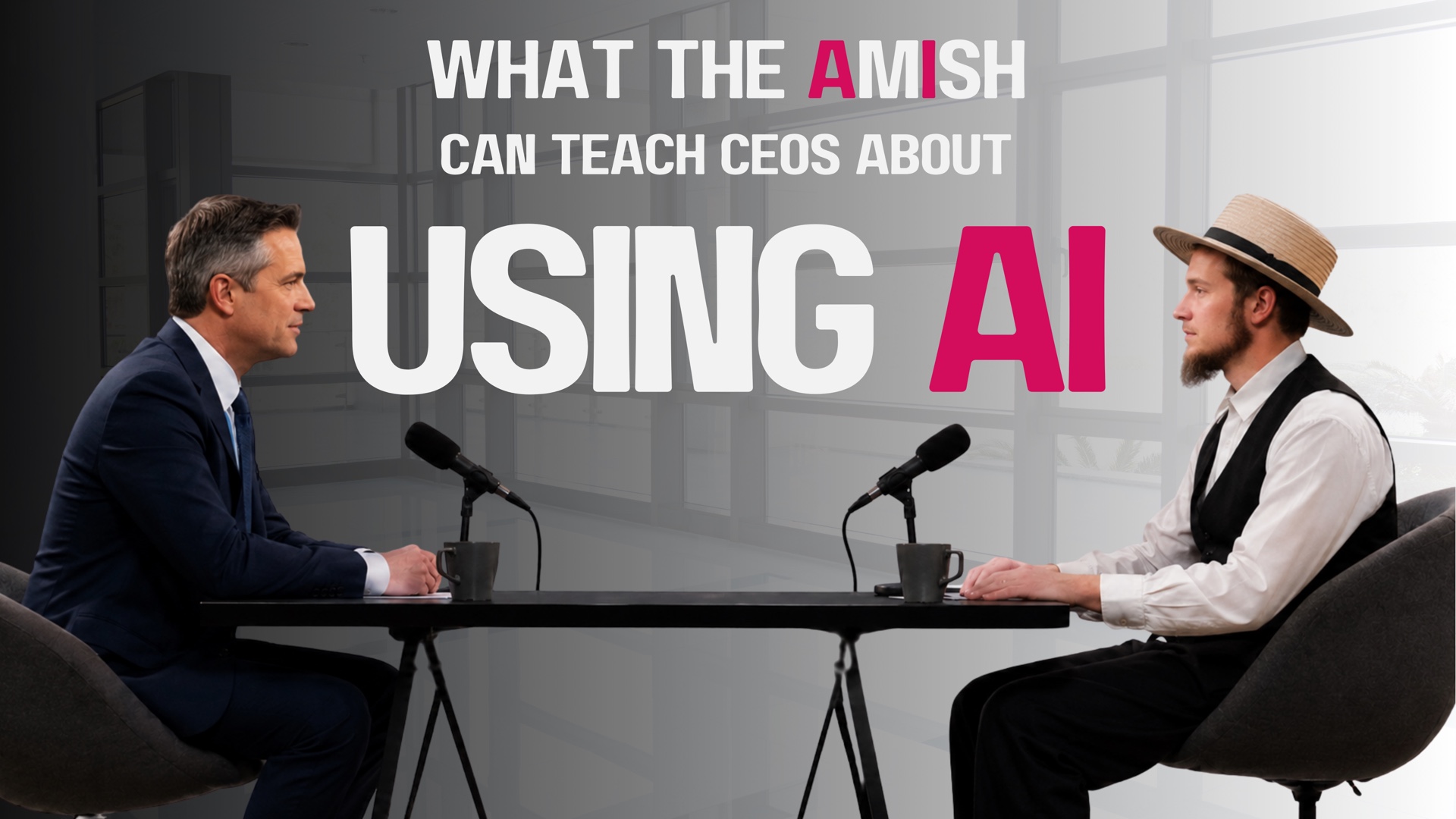
What the Amish Can Teach CEOs About Adopting AI
The Amish ban smartphones and TVs — but some are all-in on ChatGPT. The reason they're winning with AI is the same reason most companies are wasting money on it: deliberate adoption tied to outcomes, not novelty.
The right way to adopt AI is the way the Amish are doing it: deliberately, with guardrails, and only where it serves a clear purpose you can name. That sounds like a joke until you read the reporting.
In Holmes County, Ohio (the highest concentration of Amish people in the country) families who don't connect their homes to the electrical grid and ban smartphones outright are quietly running their manufacturing companies on ChatGPT and CoPilot.
One 21-year-old vibe-coded a custom production dashboard that powered his family business's highest-output month ever. A community famous for saying no to technology is making better AI decisions than most boardrooms. This piece is about why — and what it means for the CEO trying to figure out where AI actually belongs in their company.
The community that bans TVs is winning with ChatGPT
The story, reported by *New York* magazine in May 2026, is full of details that scramble your assumptions:
- A minister uses a chatbot to draft a Valentine for his wife.
- A teenager with a flip phone calls 1-800-ChatGPT from a job site because his church bans smartphones.
- A metal-fabrication shop owner uses AI to find weak clauses in 200-page subcontractor agreements… then brings in a human attorney once a contract crosses a million dollars.
What's striking isn't that the Amish are using AI. It's how.
There's no panic, no hype, and no fear of missing out. As one business owner, Daniel Wengerd, put it: "A computer's a machine that you tell to do the right thing. We just have a better way to tell it to do the right thing than in the past." AI isn't a revolution to them. It's a labor-saving tool. A mechanical reaper of knowledge work evaluated against one question: does it take away from what matters, or add to it?
That single filter is the discipline most companies are missing.
Most AI adoption is boredom in disguise
We've written before that most website redesigns happen because someone got bored, not because the numbers demanded it. AI adoption is following the exact same pattern, just faster and more expensively.
A founder comes back from a conference. A competitor announced an "AI-first" initiative on LinkedIn. The board asked a pointed question. Suddenly the directive comes down: we need an AI strategy. So the company buys seats for every tool on the market, stands up a committee, and six months later has a pile of subscriptions, a few impressive demos, and no measurable change to revenue, margin, or cycle time.
The Amish are doing the opposite, and it's worth naming the contrast plainly: a community with every cultural incentive to reject technology is adopting AI more rationally than many companies with every incentive to embrace it.
Why? Because they start with the work, not the tool. Brian Wengerd didn't adopt ChatGPT because it was new: he used it because he had a hard client email to write and a production process to track. The tool earned its place by closing a specific gap.
The guardrails are the strategy
Here's the part executives skip. The Amish aren't reckless adopters, they're constrained adopters, and the constraints are deliberate. Their internet is filtered. Smartphones are banned, so no one falls down a rabbit hole at midnight. One source put it perfectly: "I can't lay in bed for half an hour asking Chat stuff. So the times when I'm vulnerable it's not at my fingertips." But the times when they really can benefit from it? It's there.
They've effectively fenced out the downside before chasing the upside. They verify high-stakes AI output with humans — an attorney reviews the big contracts. They know enough about their own work to catch a hallucination. They've decided, as a community, exactly which doors to open and which to keep shut.
Most companies do this backwards. They open every door at once. Every team, every tool, every use case, and then scramble to write a policy after something goes wrong. The lesson from Holmes County isn't "use AI" or "don't use AI." It's decide on purpose. The companies getting real returns from AI and automation are the ones treating it like the Amish treat any new machine: with a clear answer to "what is this for, and what's the line we won't cross?"
Tie every tool to a ProfitPath® — or don't buy it
This is exactly the discipline our ProfitPaths® methodology is built to enforce. ProfitPaths® exists to map marketing and operational spend directly to revenue rather than to vanity metrics — to identify the one offering and one customer that drive your highest-margin growth, and to point every dollar at that. AI is just the newest place that discipline has to apply.
The question is never "should we use AI?" The question is: which profit path does this tool actually move? Run it through the same filter:
- What specific outcome is this closing? A slow quoting process. A drafting bottleneck. A research task eating your team's week. If you can't name the gap, you're buying a subscription, not a solution.
- What's the measurable before-and-after? Hours saved, cycle time cut, conversion lifted, cost removed. Write the number down before you deploy. If you can't, you have a demo and not a business case.
- Where's the human checkpoint? The man mentioned above brings in an attorney over a million dollars. What's your threshold, and who owns the review?
- *What are you deliberately not doing with it?* Guardrails aren't a compliance afterthought. They're the thing that lets you move fast everywhere else without the downside.
A tool that survives those four questions belongs in your business. One that doesn't is boredom with an invoice.
The executive takeaway
The popular story says technology adoption is a spectrum from Luddite to early adopter, and that winning means being further toward the "adopt everything" end. Holmes County proves that's the wrong axis entirely. The real spectrum runs from reactive to deliberate, and the Amish are far more deliberate than the average mid-market company spending six figures on AI it can't tie to an outcome.
You don't need to adopt more AI. You need to adopt it the way you'd authorize any other capital decision: against a named gap, with a number attached, a human accountable for the result, and a clear line on what it's not allowed to touch.
A tool becomes a competitive asset the same way a website does. Not by default, but when it's deployed deliberately, measured honestly, and tied to a number that matters.
Ready to Build an AI Strategy That's Tied to Profit?
If you're being pushed to "do something with AI" and you're not sure where it actually belongs in your business, that's the conversation we have every week. We'll help you separate the tools that generate profit from the ones that just move your budget. Schedule a growth strategy session and we'll map it to your numbers together.

5K Team
Our team helps companies to increase revenue, decrease costs, increase efficiency, and scale employees using digital marketing and AI technology.
Tags
Ready to Grow Your Business?
SCHEDULE A GROWTH STRATEGY SESSIONMost Recent Articles

The PPC Audit Most Companies Never Get: What a Real One Includes and How Long It Should Take
October 7, 2026
Read More

Two Agencies, One Sale: How to Split SEO and PPC Without Paying Twice for the Same Customer
October 7, 2026
Read More

5 Questions to Ask Your PPC Agency: How to Tell a Real Answer From a Polished Dodge
October 7, 2026
Read More