
November 17, 2026
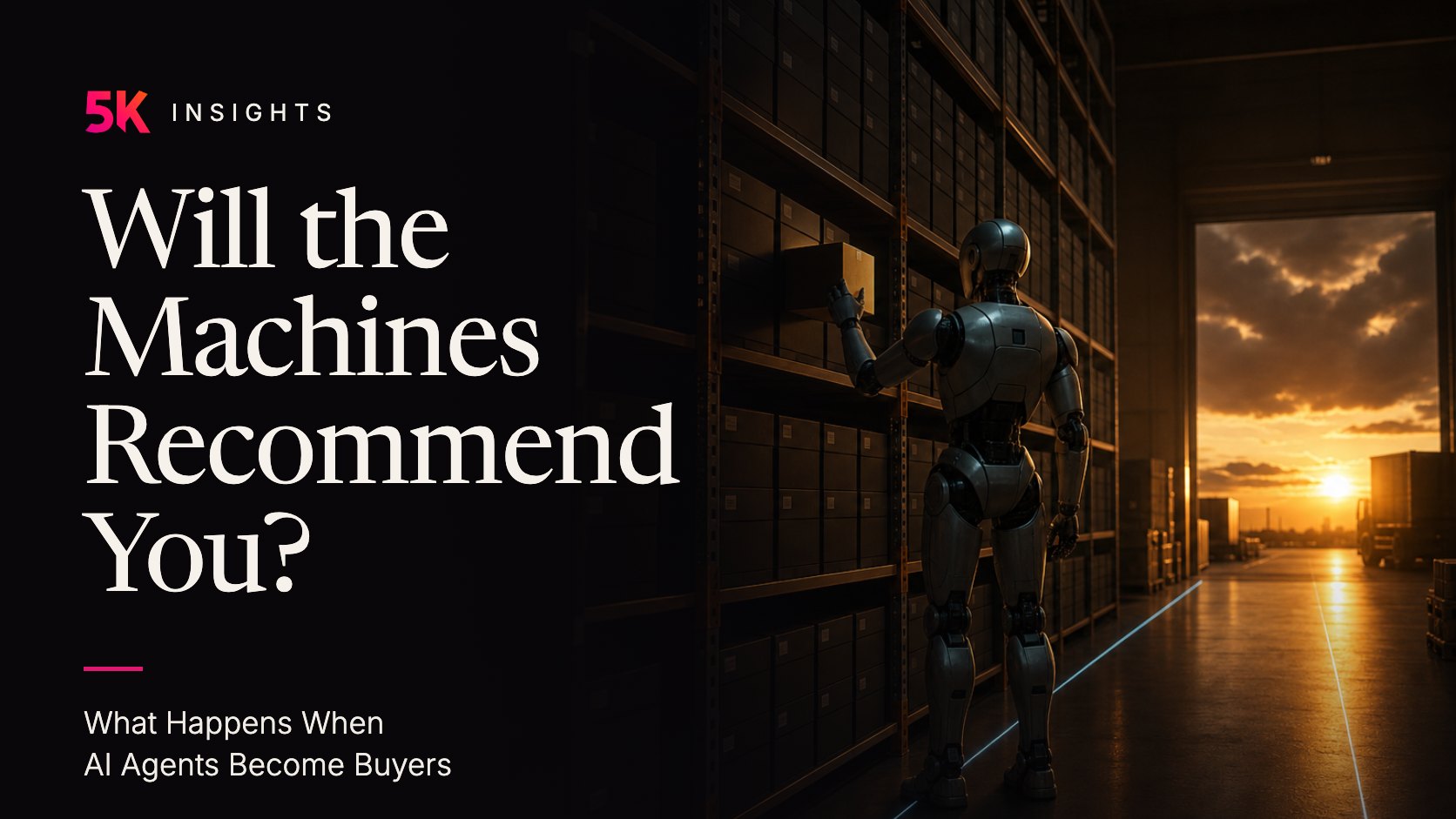
AI Agents as Buyers: How to Be the Company the Machines Recommend
AI isn't doing much of the buying yet. It is doing the shortlisting, and about 90% of B2B buyers purchase from the list they start with. Here's how to get your company on it.
A purchasing manager needs a new supplier. Five years ago she would have searched Google, opened ten tabs, and asked a colleague. Today she types one sentence into an AI assistant: find me three suppliers who can do this, in this region, at this volume, and tell me how they compare.
Thirty seconds later she has a shortlist. If your company isn't on it, you never find out there was a deal.
This is the part of the AI shift that matters most to a CEO right now. The headlines are about AI agents that complete purchases on their own, and that future is arriving slower than predicted. What's already here is quieter and more important: AI is choosing who gets considered. This guide covers what's real, what's hype, and the five things that get a company recommended.
What Does It Mean for AI Agents to Be Buyers?
An AI agent acts as a buyer when it does part of the purchasing work a person used to do: researching options, comparing vendors, building a shortlist, and in some cases placing the order. The industry term is agentic commerce.
It helps to separate three stages, because they're arriving at very different speeds.
Three stages of AI buying
Stage 1
AI recommends
A person asks an AI assistant what to buy or who to hire, and acts on the answer. This is mainstream today in both consumer and B2B buying.
Stage 2
AI shops, a person approves
The agent compares options, fills the cart or drafts the purchase order, and waits for a yes. This is live in pockets: Amazon, Perplexity, Microsoft Copilot, and some procurement software.
Stage 3
AI buys on its own
The agent purchases within rules the customer set in advance. This is rare today and limited mostly to routine reorders.
Most of the money moving because of AI today moves at stage one. That's where a mid-size company should put its attention.
The Shortlist Is Where You Win or Lose
Put two of those findings side by side. Most buyers purchase from the vendors they had in mind at the start. And more than half now build that starting list with an AI assistant.
6sense's study of nearly 4,000 B2B buyers, summarized by CustomerThink, fills in the rest. Buying groups fill four of their five shortlist spots on the first day. They buy from their top-ranked vendor 77% of the time. And they don't contact a seller until they're about 61% of the way through the process.
For most of the buying journey, your sales team isn't in the room. An AI assistant is. It's answering questions about your company using whatever it can find: your website, your reviews, trade articles, directory listings, and what other people have written about you. We described this hidden stretch of the journey in The Dark Funnel Playbook.
The effect on the buyers who do arrive is measurable. Adobe tracks traffic to U.S. retail sites, and in September 2026 visitors who came from AI tools converted 90% better than everyone else and produced 83% more revenue per visit. A year earlier, AI visitors converted 9% worse. People who arrive from an AI recommendation have already been sold.
What's Real and What's Hype
A CEO deciding where to invest needs an honest read. Here it is.
Agentic commerce in late 2026
What's real
What's still hype
Checkout inside chatbots stumbled. OpenAI launched Instant Checkout in ChatGPT in September 2025. We covered the launch at the time. In March 2026 the company pulled it back, saying the first version didn't offer enough flexibility, and shifted its focus to product discovery with purchases completed on the merchant's own site. A Walmart executive said items sold inside the chatbot converted at one third the rate of shoppers who clicked through to Walmart's site.
People aren't ready to hand over the wallet. In Accenture's survey of 25,590 consumers, 32% would let an agent make a purchase decision if they approve the payment. Only 9% would let it complete the purchase alone. B2B buyers answer the same way. In G2's 2026 Buyer Behavior Report, 47% would let an AI agent research and recommend with a person deciding. Only 2% would let it buy without approval.
AI traffic is still small. An academic study of 973 ecommerce sites, covered by Practical Ecommerce, found ChatGPT accounted for less than 0.2% of traffic through mid-2025. Adobe's numbers show fast growth from that small base, with AI-referred traffic forecast to rise 130% this holiday season.
The forecasts are large and far out. McKinsey estimates AI agents could direct up to $1 trillion of U.S. retail revenue by 2030. Gartner predicts that by 2028, 90% of B2B buying will be "AI agent intermediated." Read that word carefully. It means an AI is involved somewhere in the process. It doesn't mean software signs the purchase order.
The takeaway for a mid-size company: don't rebuild your business around automated checkout this year. Do make sure AI can find you, understand you, and recommend you. That work pays off at every stage.
How AI Decides Who to Recommend
AI assistants don't have a list of preferred vendors. They assemble an answer from what they can read. Research on what they favor points in a consistent direction.
Being mentioned matters more than being linked. Ahrefs studied 75,000 brands to see what tracks with visibility in Google's AI answers. The strongest factor was how often a brand is mentioned across the web. The number of backlinks, the traditional SEO measure, was one of the weakest. Ahrefs notes these are correlations. The pattern still makes sense: an AI that sees your company named in many credible places concludes you're a real option.
Reviews carry weight. In G2's 2026 report, review sites were the top source buyers used to build shortlists, just ahead of AI chatbots. The chatbots read those same reviews.
Shortcuts don't work. A file called llms.txt has been promoted as a way to tell AI what to read on your site. SE Ranking analyzed about 300,000 domains and found no clear effect on how often AI cites a site.
Specifics get picked up. An AI answering "who can do this job in my area at this volume" needs facts it can match against the request. Companies that publish what they make, where they serve, their capacity, their certifications, and their pricing give it something to work with.
Five Things That Get Your Company Recommended
What an AI needs in order to choose you
1. Publish the facts a buyer would ask for
Specifications, service areas, lead times, minimum orders, certifications, and pricing or price ranges, in plain text on public pages. If the answer is locked in a PDF, a gated download, or a salesperson's head, the AI can't use it. We covered the cost of hiding content in Gated Content Is Costing You More Leads Than It Captures.
2. Say the same thing everywhere
Your website, Google Business Profile, directory listings, distributor pages, and sales materials should agree on what you do and who you serve. Conflicting information makes an AI less confident, and it will recommend the competitor it's sure about.
3. Get other people talking about you
Trade press, industry associations, customer reviews, podcasts, and credible directories. Original data and useful tools earn those mentions, which is the idea behind high-end link bait.
4. Make your information machine-readable
Structured data on your site tells AI what a page contains: a product, a price, a service area, a review. Ecommerce companies should keep product feeds complete and current. OpenAI's product feed specification requires nine fields, including price, availability, and seller name. Our guide to structuring technical data for AI covers the industrial side.
5. Measure whether it's working
Ask the major AI assistants the questions your buyers ask, monthly, and record whether you appear and what's said about you. Track visits from AI tools in your analytics. Here's how to set that up.
None of this is exotic. It's the discipline of being easy to understand and easy to verify, applied to a new kind of reader.
What This Means by Type of Business
Manufacturers and industrial companies. Your buyers are engineers and purchasing managers who research alone for months. They're asking AI to compare suppliers by capability, certification, and capacity. Put those facts on the page. Large buyers are also automating procurement: Walmart's supplier negotiation chatbot reached agreements with 64% of suppliers in its pilot, and SAP is adding AI assistants for sourcing and supplier management to its procurement software. See our guide to GEO for manufacturing.
Home services and local businesses. A homeowner asks an assistant who to call for a failed furnace tonight. The AI leans on reviews, your Google Business Profile, service-area pages, and whether your hours and pricing are stated. Volume and recency of reviews matter more than ever.
Ecommerce and consumer brands. You're closest to stage two. Keep product data complete, keep prices and availability current in every feed, and watch AI referrals as their own channel. Hold off on custom checkout integrations until one of them proves it sells.
The Risks to Watch
Three issues are unsettled, and each could change the rules.
Platforms are fighting over access. Amazon sued Perplexity over its shopping agent. A federal appeals court sided with Perplexity in August 2026, in a narrow ruling, and the case continues. Amazon's robots.txt file, which tells automated visitors what they may access, now blocks dozens of AI agents. If you depend on a marketplace for sales, your visibility to outside AI tools depends on that marketplace's choices.
AI gets facts wrong. One vendor study reported by Tech.co found conflicting or incorrect information in 86% of AI shopping answers. The more clearly and consistently you publish your own facts, the less room there is for an AI to guess.
A lot of traffic isn't human. Akamai reports that automated traffic made up nearly 48% of commerce traffic by the end of 2025. Your analytics need to separate AI assistants acting for real customers from scrapers, and your site should welcome the first group.
What This Looks Like in Practice
Camp Highlander, a summer camp in North Carolina, is a simple example of the stage-one win. We built content that answered the questions parents ask, with specifics about the camp's program and location. In one season the camp ranked first on Google for a national search, appeared in Google's AI Overview, and was cited in ChatGPT and Perplexity. When a parent asked Perplexity for a camp with a specific structure in that area, it named Camp Highlander as the best fit and cited the camp's own article. The full story is here.
That's what being on the shortlist looks like. The parent never opened ten tabs.
Interactive scorecard
Would an AI recommend your company?
Tick every statement that's true for your company right now.
Red flags checked
0 / 7
Nothing checked yet.
Tick each statement that's true for your company today. Nobody else sees this.
Book My Free Strategy SessionStart With the Shortlist
The fully automated buyer is coming, and nobody knows the date. The AI-built shortlist is here now, and the companies on it are winning deals their competitors never hear about.
Getting on that list takes clear facts, consistent information, credible mentions, and a way to measure progress. That's the work our SEO and AI search team does, and it starts with seeing what AI says about you today. For the CEO-level overview of this shift, see How Your Business Can Stay Visible in the Age of AI Search.
Frequently Asked Questions
What is agentic commerce?
Agentic commerce is buying and selling in which AI agents do some of the work for the customer: researching products, comparing vendors, building a shortlist, and sometimes completing the purchase. Today most activity is in research and recommendation. Fully automated purchasing is still limited.
Are AI agents making purchases on their own yet?
Rarely. OpenAI pulled back its in-chat checkout in March 2026, and surveys show only about 9% of consumers and 2% of B2B buyers would let an agent buy without approval. Agents that shop and wait for a person to approve are live on Amazon, Perplexity, and Microsoft Copilot.
How do B2B buyers use AI when choosing vendors?
They use AI assistants to identify vendors, compare them, and build a shortlist before contacting anyone. In G2's 2026 research, 51% of B2B software buyers start with an AI chatbot more often than Google, and 69% said an AI recommendation led them to choose a different vendor than they had planned.
How do I get my company recommended by ChatGPT or other AI assistants?
Publish specific facts about what you sell, where, and for how much. Keep those facts consistent across your website and listings. Earn mentions and reviews on credible third-party sites. Add structured data so AI can read your pages accurately. Then test the questions your buyers ask each month and track the results.
Does llms.txt help with AI visibility?
There's no evidence that it does. An analysis of about 300,000 domains by SE Ranking found no clear effect of llms.txt on how often AI systems cite a site. Clear content, consistent business information, and third-party mentions matter more.
Should my company build for AI checkout now?
For most mid-size companies, no. In-chat checkout hasn't proven itself as a sales channel. Ecommerce companies should keep product feeds complete and current so they're ready when it matures. Every company should focus first on being recommended, because that's where AI is influencing purchases today.

5K Team
Our team helps companies to increase revenue, decrease costs, increase efficiency, and scale employees using digital marketing and AI technology.
Tags
Ready to Grow Your Business?
SCHEDULE A GROWTH STRATEGY SESSIONRelated Articles
Revenue Per Employee by Industry: The Benchmarks Every CEO Should Know Before the Next Hire
November 17, 2026
Read More
Marketing Budget as a Percentage of Revenue: The Real Benchmarks, and a Better Way to Set Yours
November 17, 2026
Read More
How to Measure AI ROI: The One-Page Scorecard to Bring to Your Board
November 17, 2026
Read More