AI is everywhere right now.
Every company is talking about it. Every leadership team is wondering how to use it. Every CEO is being told that AI is going to change the way business works.
But there is a problem.
According to the PwC Global CEO Survey referenced in our recent podcast, 56% of CEOs reported that they have seen zero revenue gain and zero cost savings from AI. That number is shocking, but it is not surprising.
Because for most companies, the issue is not that AI does not work.
The issue is that they are using it wrong.
AI Does Not Fail. Poor Implementation Fails.
This same pattern has played out before.
Years ago, companies tried Google Ads. Many said it “didn’t work.” Then another company in the same industry used Google Ads properly and generated millions of dollars in revenue.
The difference was not the platform.
The difference was the strategy, execution, and expertise behind it.
The same thing is happening with AI.
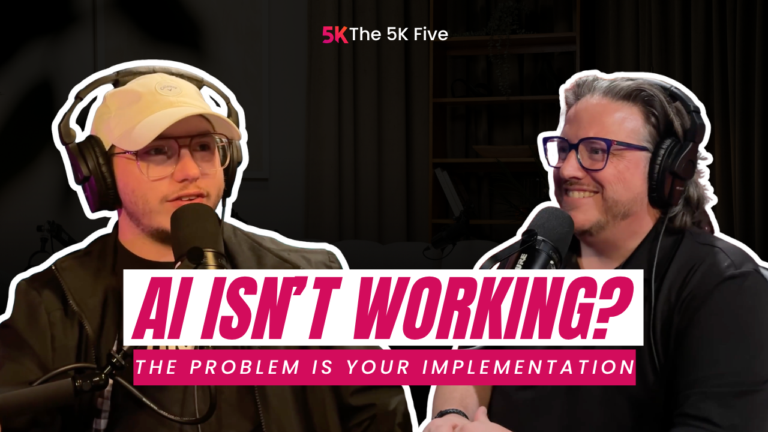
A lot of companies think “doing AI” means giving employees a ChatGPT account and telling them to experiment. That is not AI integration. That is just access to a tool.
Real AI implementation means taking actual business processes, identifying where time and money are being wasted, and building systems that allow AI to improve those workflows.
That is where the return comes from.
The Companies Winning With AI Are Solving Real Problems
The CEOs who are seeing results from AI are not using it as a novelty.
They are using it to solve specific operational problems.
For example, inside a marketing company, one common task is monitoring client ad budgets. Without automation, someone may need to log into Google Ads, Meta, Bing, TikTok, YouTube, and other platforms one account at a time.
Then they have to compare current spend against monthly goals, calculate pacing, and decide what needs to change.
Across dozens of clients, that can turn into hours of manual work every week.
With AI and the right integrations, that same process can be turned into a dashboard that pulls the data together, compares it against budget goals, and recommends what needs to happen next.
That is not just “using AI.”
That is using AI to save time, reduce errors, and improve decision-making.
AI Should Be Built Into Your Existing Processes
One of the biggest mistakes companies make is treating AI like a separate activity.
They test it on the side. They ask employees to play around with prompts. They look for generic use cases that sound impressive but do not connect to how the business actually operates.
That rarely produces meaningful results.
AI becomes valuable when it is connected to your existing systems and standard operating procedures.
Take a company that prepares fencing estimates from contractor blueprints. A seasoned estimator may spend 30 minutes reviewing drawings, counting materials, preparing a quote, entering information into the system, and organizing the next steps.
AI can be trained to assist with that process.
It can review information, extract details, calculate quantities, prepare summaries, and help generate quotes faster. That does not necessarily mean replacing the employee. It means freeing that person to focus on higher-value work, quality control, customer interaction, and better systems.
That is how AI should be viewed.
Not as a toy.
Not as a threat.
As leverage.
A Chatbot Is Not an AI Strategy
There is a major difference between using ChatGPT and building AI into your company.
A chatbot can answer questions. It can help write emails. It can summarize documents. Those things are useful, but they are only the surface level.
Real AI strategy goes deeper.
It connects with your software. It works with your data. It supports your internal workflows. It helps your team move faster without lowering quality.
That is why some companies are building internal tools, dashboards, reporting systems, sales assistants, estimating tools, financial analysis systems, and marketing engines with AI.
These are not generic prompts.
They are business systems.
And that is where AI starts to create real financial impact.
Every Department Can Be Amplified With AI
There is not one position in a company that cannot be improved with AI in some way.
Marketing can use AI to build campaigns, analyze performance, create landing pages, and identify opportunities faster.
Finance can use AI to review data, identify trends, surface outliers, and provide clearer reporting.
Sales can use AI to organize lead information, personalize outreach, and improve follow-up.
Operations can use AI to reduce repetitive admin work, improve quoting, manage workflows, and standardize processes.
Legal and executive teams can use AI to review complex documents, summarize key points, and prepare better questions before involving outside counsel.
The opportunity is not limited to technical roles.
The opportunity is everywhere.
The Real Barrier Is Not Technology
Most companies do not fail with AI because the technology is weak.
They fail because they do not know what to build.
They do not know which workflows to improve first. They do not know how to connect AI to their existing systems. They do not know how to evaluate whether an AI solution is actually useful.
That is why hiring the right people matters.
If you are evaluating someone to help with AI, do not ask them to talk about AI in theory. Give them a real problem from your business and ask them to show you a solution.
Not a slide deck.
Not a generic chatbot demo.
A real solution.
If they can take a specific business problem and show you how AI can solve it inside your actual workflow, you may have found someone worth listening to.
AI ROI Comes From Practical Execution
The companies seeing revenue growth and cost savings from AI are not lucky.
They are practical.
They are taking processes that already exist and making them faster, smarter, and more efficient. They are using AI to remove bottlenecks. They are connecting AI to the tools they already use. They are building systems around real business needs.
That is the difference between experimenting with AI and actually implementing AI.
One creates curiosity.
The other creates return.
The Bottom Line
If your company is not getting a return from AI, it does not mean AI does not work.
It probably means AI has not been applied to the right problems yet.
The opportunity is not simply to “use AI.” The opportunity is to look at the work your company already does every day and ask a better question:
Where are we wasting time, money, or talent on work that AI could help improve?
That is where the return begins.