Manufacturing Spotlight: How to Structure ISO, FDA, and Compliance Data So AI Scouts Find You First
Share
AI vendor discovery platforms like Zapro.ai and Scoutbee use web crawling, structured data parsing, and natural language processing to autonomously build supplier databases and shortlist manufacturers for procurement teams.
So what?
Let’s get into that.
Here’s the deal: these systems prioritize vendors whose digital presence includes machine-readable certification data, schema-marked compliance credentials, and structured capability information rendered in accessible HTML. Manufacturers whose ISO certifications, FDA registrations, and regulatory compliance details live in PDFs or dense unstructured prose are functionally invisible to this new layer of procurement technology.
5K’s approach to technical extraction for AI vendor discovery combines structured data implementation, schema markup, and Citation Authority optimization through 5K Analytics to ensure manufacturers are found first when AI scouts search their category.
THE CEO TAKEAWAY:Your ISO 9001 certification, your FDA registration, your ITAR compliance, your AS9100 credentials — these are the qualifying criteria that determine whether you make a buyer’s shortlist. If that data is buried in a PDF or written in dense prose on a capability page, AI procurement platforms cannot read it. Which means when a Fortune 500 sourcing team uses Zapro.ai or Scoutbee to find qualified suppliers, your name does not appear. The vendors winning the next decade of B2B procurement are the ones making their compliance data machine-readable first.
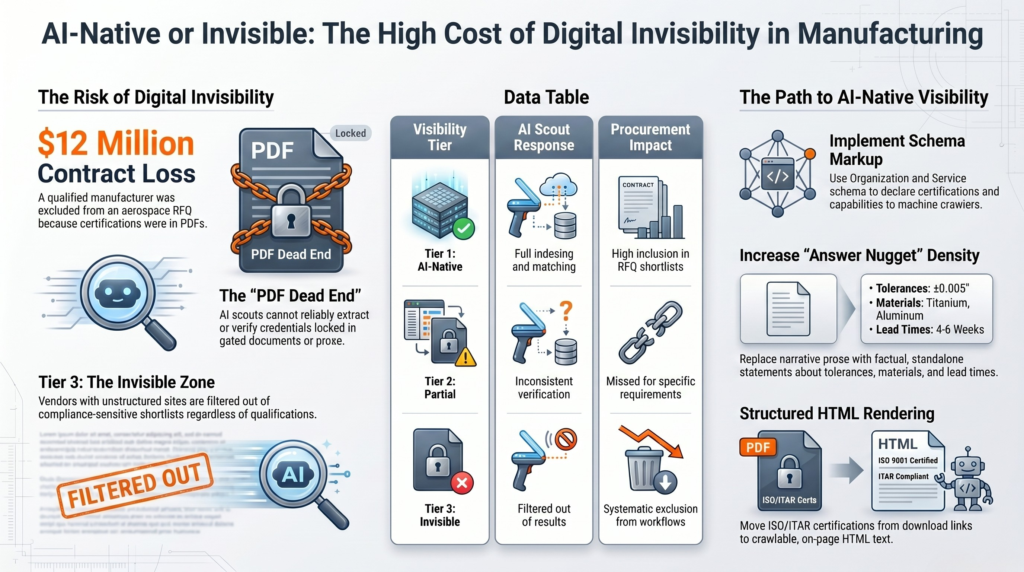
The $12 Million Contract Lost to a Spreadsheet
I have a close friend who works for a company out of the Midwest. We were recently chatting around the fire — chopping it up and getting into family, friends, and work (of course). He shared the following story with me… and it was one of those moments (I’m told songwriters experience this) where I was like “well, I know what I’m writing about next.”
He dropped this: A precision components manufacturer in the Midwest (where he works) spent 40 years building a reputation for quality. ISO 9001:2015 certified. AS9100 Rev D certified for aerospace. ITAR registered. Nadcap accredited for special processes. They held certifications that represented millions of dollars of audit investment and decades of operational discipline.
Last year, a major aerospace prime contractor issued an RFQ for a multi-year precision machining contract worth an estimated $12 million over five years. The sourcing team used an AI-driven supplier discovery platform to build their initial qualified vendor list. The platform searched public-facing supplier data across North America, evaluated capability matches, filtered for required certifications, and produced a shortlist of twelve candidates.
The Midwest manufacturer was not on the list.
When their sales director (the same one I was sitting around the fire with) found out about the opportunity three weeks later (through a relationship at the prime contractor), he could not understand it. His company held every required certification. Their capabilities were a direct match. They had been a qualified supplier to the same prime on a previous contract.
The issue was not their qualifications. The issue was their website.
Their ISO certifications were listed in a PDF linked from a downloads page. Their AS9100 credential appeared in a single sentence on an About Us page. Their ITAR registration was mentioned only in a company overview document hosted as a gated PDF behind a form. Their Nadcap accreditation was not mentioned anywhere publicly at all. Every certification was real. None of it was structured in a way that an AI procurement platform could extract and index.
The platform’s crawl found plenty of capability language on their site but could not verify any of the regulatory credentials that would have qualified them for the shortlist.
So it moved on.
Twelve competitors with less experience and weaker track records were evaluated instead, because their certifications were embedded in structured, extractable HTML that the AI system could parse.
The Midwest manufacturer did not lose the contract because they were the wrong supplier. They lost it because they were invisible to the system that decided who got to compete for it.
This is the new reality of B2B procurement in 2026. AI-driven supplier discovery is no longer an emerging trend. It is the mechanism through which an increasing percentage of qualified vendor lists are being assembled, and the rules of visibility have changed completely.
What AI Vendor Discovery Actually Does
AI vendor discovery platforms are purpose-built systems designed to help procurement teams identify, evaluate, and shortlist suppliers at scale. Unlike traditional supplier databases that rely on self-reported vendor profiles, these platforms autonomously crawl the open web, parse structured and unstructured data, and build comprehensive supplier intelligence that updates continuously.
The major platforms in this category (Zapro.ai, Scoutbee, Tealbook, Keelvar, and others) share a common technical architecture. They use web crawlers to gather public-facing data from manufacturer websites, trade association directories, certification body registries, and industry databases. They use natural language processing to interpret capability descriptions, product specifications, and service offerings. And they use machine learning models to match buyer requirements against the parsed supplier intelligence, producing ranked shortlists that procurement teams use as their starting point for vendor evaluation.
The critical shift for manufacturers is that AI vendor discovery platforms prioritize structured, machine-readable data over marketing language. A manufacturer with three specific sentences of schema-marked ISO certification data will be more discoverable than a competitor with five paragraphs of eloquent copy about their commitment to quality. The platforms are not evaluating prose. They are extracting facts, matching them against requirements, and filtering vendors based on verifiable credentials.
This is the exact opposite of how most manufacturers have structured their websites historically. Traditional B2B marketing rewarded compelling narrative, emotional differentiation, and brand storytelling. AI procurement rewards factual precision, structural clarity, and machine-extractable detail. Both audiences still matter (human buyers still read websites when they eventually visit), but the AI scout now sits upstream of the human buyer in many procurement workflows, deciding which vendors even get the chance to tell their story.
The Three Tiers of Manufacturer Visibility to AI Scouts
Not every manufacturer website is equally invisible to AI vendor discovery platforms. 5K’s technical audits of manufacturer sites reveal three distinct tiers of AI scout visibility, each with predictable implications for procurement outcomes.
Visibility Tier
What the Site Looks Like
How AI Scouts Respond
Procurement Impact
Tier 1: AI-Native
Certifications, capabilities, and compliance data rendered in structured HTML with schema markup, FAQ blocks, and accessible detail pages
Full indexing with accurate capability and certification matching; manufacturer appears in relevant shortlists
High inclusion rate in AI-assembled qualified vendor lists; early consideration in RFQ processes
Tier 2: Partially Extractable
Some capability and certification data in HTML, but significant portions locked in PDFs, behind forms, or in unstructured prose
Partial indexing with gaps in certification verification; inconsistent inclusion in shortlists depending on query specificity
Medium inclusion rate; often appears for general queries but missed for specific compliance-driven requirements
Tier 3: AI-Invisible
Certifications exist only in PDF downloads, gated documents, or unstructured company overview pages; no schema markup
Minimal indexing; cannot verify certifications or specific capabilities; effectively filtered out of compliance-sensitive shortlists
Low inclusion rate; vendors in this tier are systematically excluded from AI-driven procurement workflows regardless of actual qualifications
Industrial buyers increasingly expect certifications, compliance documents, and technical proof to be easily discoverable online. Recent manufacturing website guidance and buyer-journey research emphasize that certifications should be visible, downloadable, and supported by structured data rather than buried in PDFs or generic ‘about’ content.
The brands still sitting in Tier 3 as AI procurement platforms scale over the next 24 months will experience a compounding disadvantage. Being invisible to the first pass of vendor discovery means being excluded from opportunities before human procurement professionals ever see the vendor universe, and the gap between visible and invisible vendors will widen every quarter as more sourcing workflows incorporate AI-driven discovery.
The Five Technical Requirements for AI-Native Visibility
Moving from Tier 3 to Tier 1 is not a branding project. It is a technical implementation project with five specific requirements, each addressing a different aspect of how AI platforms extract and verify manufacturer credentials.
1. Structured HTML Rendering of All Certifications
Every meaningful certification, accreditation, and compliance credential should appear as structured HTML content on your website, not exclusively in PDFs or gated downloads.
The practical implementation means creating dedicated HTML sections (or full pages for regulated industries) that explicitly name each certification with its full formal designation, issuing body, scope of coverage, and current status. “ISO 9001” is less useful than “ISO 9001:2015 Quality Management System, certified by [Registrar Name], covering all operations at [Facility Location], initially certified [Year], current through [Expiration].” The former is parseable but lacks verification context. The latter provides the specific entity data that AI platforms can match against precise procurement requirements.
For manufacturers in regulated industries (medical device, aerospace, defense, food and pharmaceutical), this typically means building out a comprehensive certifications page that functions as a single source of truth, along with relevant certification details embedded contextually within specific capability pages. The goal is that any AI scout crawling your site can answer specific certification questions without needing to download, parse, or authenticate against external documents.
2. Schema Markup for Organization, Product, and Service Entities
Schema markup is the machine-readable data layer that tells AI platforms exactly what your content represents. Without it, a crawler sees text but must infer meaning. With it, the crawler sees explicit declarations of entity types, relationships, and attributes.
For manufacturers, the critical schema implementations include:
Organization schema declaring your company identity, industry classification, certifications held, and primary service area
Service schema defining each distinct capability or service offering with clear attributes (precision tolerances, materials handled, industries served, volume capacity)
Product schema for manufacturers with specific product catalogs, including detailed specifications and compliance attributes
FAQPage schema for frequently asked qualifying questions, which is one of the highest-extractability content formats for AI indexing
The difference schema makes in AI scout visibility is substantial. 5K has documented manufacturer sites that saw a 3-to-5x increase in AI citation frequency within 90 days of implementing comprehensive schema markup, without changing any underlying content. The information was already present; it just was not machine-readable until schema was added.
3. Capability Pages With High Answer Nugget Density
Answer Nugget Density is a GEO metric that measures the number of self-contained, extractable answer statements per 1,000 words of content. For AI vendor discovery purposes, capability pages with high Answer Nugget Density dramatically outperform capability pages written in continuous prose.
What this looks like in practice is capability pages structured around specific, parseable statements rather than flowing marketing narrative. Instead of “Our precision machining capabilities represent decades of experience serving the most demanding industries with exceptional quality,” the high-density version reads: “We machine aerospace-grade aluminum, titanium, and Inconel alloys. Our tolerance capability is ±0.0002 inches on precision components. We hold AS9100 Rev D certification for aerospace applications and ITAR registration for defense work. Average turnaround for prototype runs is 10 business days.”
Each sentence in the second version is an extractable answer nugget that addresses a specific procurement question: What materials? What tolerances? What certifications? What lead times? This is the kind of content AI platforms reward with citations, because each fact stands alone and matches cleanly against buyer requirements.
Much of the highest-value manufacturer information historically lives in technical documentation: spec sheets, capability statements, compliance attestations, and process documents. Most of this content has traditionally been distributed as PDFs, often gated behind contact forms or hosted on separate file servers.
For AI scout visibility, this content needs to exist as crawlable HTML in addition to any PDF versions you continue to distribute. That does not mean eliminating PDFs (many buyers still prefer them for download and reference), but it does mean that every fact contained in a PDF should also be discoverable as structured web content that search engines and AI platforms can index without authentication.
For manufacturers with extensive technical libraries, this often becomes a significant content architecture project. The investment pays back quickly in AI visibility, but it requires intentional planning around how technical data is structured, organized, and interlinked across the site.
5. Continuous Citation Authority Measurement
The four requirements above are implementation projects. The fifth is an ongoing measurement discipline, because AI vendor discovery platforms and the AI search engines powering broader procurement research evolve continuously.
For manufacturers specifically, Citation Authority measurement tracks visibility across two overlapping layers: AI search platforms where buyers research vendors conversationally (ChatGPT, Gemini, Perplexity), and the AI vendor discovery platforms used by procurement teams directly (Zapro.ai, Scoutbee, Tealbook). 5K Analytics provides the unified dashboard that tracks citation performance across both layers, giving manufacturers ongoing visibility into whether their technical extraction work is translating into actual discoverability gains.
Without this measurement layer, you are investing in structural improvements without the feedback loop that tells you which improvements are producing results and which gaps still need attention.
How This Connects to Broader GEO Strategy
Technical extraction for AI vendor discovery is not a separate marketing discipline from broader Generative Engine Optimization. It is a specific, high-stakes application of GEO principles to the procurement layer of B2B marketing. The same technical extractability that makes your certifications findable by Zapro.ai also makes your capabilities citable by ChatGPT when a plant engineer asks conversational research questions during the Dark Funnel phase of their buying journey, which we explored in depth in our recent article on The Dark Funnel Playbook: How B2B Buyers Research in AI Before They Ever Visit Your Website.
This is why 5K approaches manufacturer GEO as an integrated program rather than a series of one-off optimizations. Our 5K SEO services combine technical extraction work, content architecture, schema implementation, and ongoing Citation Authority measurement into a unified strategy sequenced through the RAMP!™ strategic roadmap. The goal is to build a Topical Moat around your manufacturing category — a defensible position where your brand is consistently the cited authority across both AI vendor discovery platforms and broader AI search engines.
For manufacturers with existing GEO investments, layering AI vendor discovery optimization on top is often a straightforward extension rather than a new initiative. For manufacturers still operating on pre-AI website architectures, the transition typically requires a more comprehensive rebuild of how technical and compliance data is structured, but the ROI is significant because each piece of extraction work pays dividends across multiple AI platforms simultaneously.
Beyond technical extraction, manufacturers looking to build a complete growth program that aligns content strategy with paid media should also explore our 5K Strategy services, which connect GEO investments to broader revenue and pipeline goals, and 5K Ads for AI-driven paid media management that works in concert with citation-optimized organic content.
What Procurement Teams Are Actually Doing With These Tools
Understanding how procurement teams use AI vendor discovery platforms helps manufacturers prioritize which aspects of their digital presence to optimize first. The typical workflow looks like this:
A procurement specialist receives a sourcing request with specific requirements: material capabilities, certifications, volume requirements, geographic preferences, and target price range. They input these requirements into a platform like Zapro.ai or Scoutbee. The platform returns a ranked list of 15 to 40 candidate suppliers, filtered to match the stated requirements. The procurement team evaluates the top candidates, typically conducting deeper research on the top 8 to 12 before shortlisting 4 to 6 for formal RFQ.
In this workflow, three manufacturer characteristics determine shortlist inclusion more than any others:
Verifiable certification match. Can the platform confirm you hold the specific certifications required? This is a binary filter in most implementations. No verifiable certification data means exclusion.
Capability specificity. Does your site contain the specific technical language matching the sourcing requirement? “Precision machining” is too broad to match “tight-tolerance CNC machining of titanium components for aerospace applications.” Specificity wins.
Content freshness and depth. Platforms weight recent, comprehensive, detailed content higher than sparse or outdated information. Manufacturers with actively maintained capability content consistently outperform those with static, rarely-updated sites.
Optimizing for these three factors does not require abandoning your brand or sacrificing your marketing voice. It requires adding the structured, factual, extractable layer underneath your existing content that makes AI platforms able to verify and match your qualifications.
Learn more about how to capitalize on GEO rankings in the zero-click age 👇
Frequently Asked Questions
What is AI vendor discovery?
AI vendor discovery is the use of AI-driven platforms like Zapro.ai, Scoutbee, Tealbook, and Keelvar to autonomously identify, evaluate, and shortlist suppliers for procurement teams. These platforms crawl manufacturer websites, parse structured and unstructured data, and use machine learning to match vendor capabilities against specific procurement requirements, producing ranked qualified vendor lists.
Why are some manufacturers invisible to AI vendor discovery platforms?
Manufacturers become invisible to AI vendor discovery platforms when their certifications, capabilities, and compliance data are locked in PDFs, gated behind forms, or written in unstructured prose that machine crawlers cannot reliably parse. AI platforms prioritize structured HTML content with schema markup, which makes certification and capability data machine-readable and verifiable.
What schema markup should manufacturers implement?
Manufacturers should implement Organization schema declaring company identity and certifications, Service schema defining specific capabilities with clear attributes, Product schema for distinct product offerings, and FAQPage schema for common qualifying questions. Person schema is also recommended for authored content to support E-E-A-T signals. Comprehensive schema implementation typically increases AI citation frequency by 3 to 5 times within 90 days.
How do AI scouts verify manufacturer certifications like ISO 9001 or AS9100?
AI scouts verify manufacturer certifications by parsing structured HTML content that explicitly names the certification, the issuing body, the scope of coverage, and current status. Certifications mentioned only in PDFs, gated documents, or unstructured prose cannot be reliably verified and often result in the manufacturer being excluded from compliance-filtered shortlists.
What is Answer Nugget Density and why does it matter for capability pages?
Answer Nugget Density measures the number of discrete, self-contained answer statements per 1,000 words of content. For manufacturer capability pages, high Answer Nugget Density means each sentence directly addresses a specific buyer question (materials, tolerances, certifications, lead times). 5K targets a minimum of six answer nuggets per 1,000 words for all GEO-optimized content, which significantly improves AI citation and vendor discovery platform matching.
How long does it take to improve AI vendor discovery visibility?
Most manufacturers working with 5K see measurable improvements in AI platform visibility within 60 to 90 days of implementing schema markup and restructuring compliance content for extractability. Meaningful improvements in shortlist inclusion rates typically occur within 4 to 6 months as AI vendor discovery platforms re-crawl and re-index the improved content.
5K Team
Our team helps companies to increase revenue, decrease costs, increase efficiency, and scale employees using digital marketing and Ai technology.