If you have been running paid media for more than a few years, you have probably developed a working mental model of how the major ad platforms operate. You know the difference between Search and Display, you understand how bidding works, and you can navigate Google Ads and Meta Ads Manager without thinking too hard about it.
That mental model is about to get scrambled.
Between Google’s accelerating push into AI-driven campaign types, the expansion of Smart Campaigns beyond their original small-business audience, and the early rollout of ChatGPT Ads, the paid media landscape in 2026 looks meaningfully different than it did even 12 months ago. Some of these changes are opportunities. Some are landmines. And a few are genuinely confusing, even for experienced advertisers.
Here is what each of these platform shifts actually means, who should care, and what to do about them right now.
Google AI Max: The Quiet Revolution in Search Campaigns
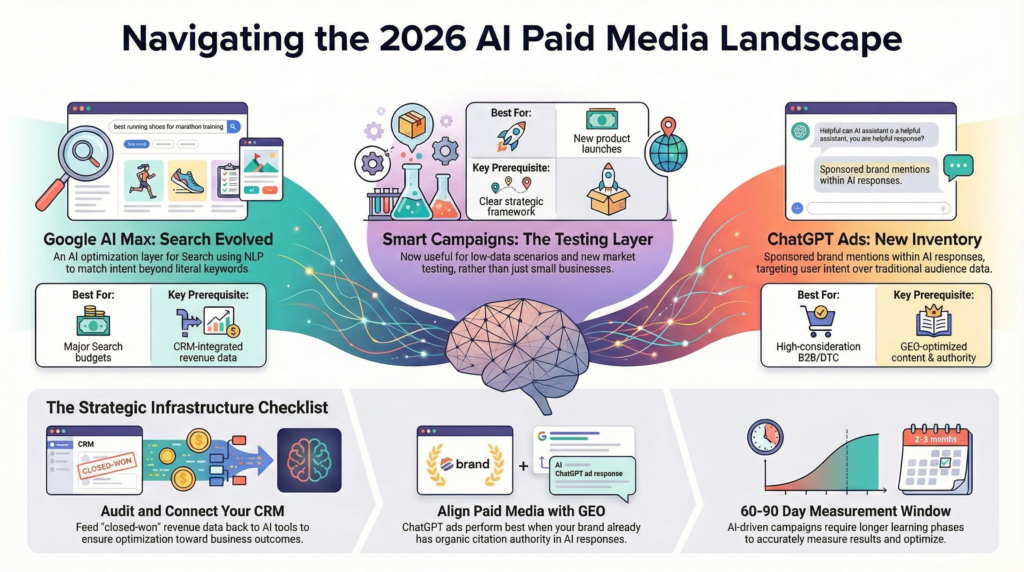
Google AI Max is the platform’s latest evolution of its AI-driven bidding and targeting framework, and it represents a significant step beyond the Smart Bidding and Performance Max tools that preceded it. Where Performance Max gave Google’s AI control across multiple inventory types, AI Max brings similar AI-driven intelligence directly into Search campaigns specifically, blending broad match intent matching, automated asset generation, and dynamic landing page selection into a unified optimization layer.
What it actually does
AI Max uses natural language processing to match your ads against buyer queries far beyond the literal keywords you enter. It generates headlines and descriptions on the fly based on the specific query and buyer context. It can dynamically select the most relevant landing page from your site based on user intent, rather than sending everyone to the same URL you assigned at the ad group level.
Who should care
Any business running Google Search campaigns as a meaningful portion of their paid media budget. That is essentially every B2B manufacturer, every high-ticket DTC brand, and most growth-stage businesses. AI Max is not an optional feature to test on the side. Google is systematically positioning it as the default optimization layer for Search, and advertisers who resist will find themselves outcompeted by those who embrace it.
The catch
AI Max performs exceptionally well when it is fed strong conversion data and performs poorly when it is not. If your account is still optimizing toward raw form submissions or on-platform conversions without LTV data flowing back into the system, AI Max will optimize efficiently toward the wrong outcomes. This is the same principle that applies to autonomous paid media more broadly, and it is covered in depth in our deeper GEO article on autonomous paid media for industrial brands.
What to do right now
Audit your conversion tracking before enabling AI Max at scale. If your conversion data is limited to form fills and basic ecommerce purchases, fix that first. Connect your CRM so pipeline stage changes and closed-won revenue flow back to Google Ads as offline conversions. Then let AI Max operate within properly configured campaigns and measure the results over a 60-to-90-day window.
Google Smart Campaigns: Not Just for Small Businesses Anymore
Smart Campaigns were originally released as a simplified campaign type for small businesses that did not have the expertise or time to manage traditional Google Ads structures. The original positioning was essentially “set up an ad in 15 minutes and let Google handle the rest.” For years, sophisticated advertisers ignored Smart Campaigns entirely because they removed too much control.
That positioning has shifted. In 2025 and into 2026, Google has expanded Smart Campaigns to include more targeting control, better reporting, and integration with Performance Max and AI Max features. The result is a campaign type that now sits somewhere between the fully simplified original version and the full-control traditional structures, making it an interesting option for specific use cases even among experienced advertisers.
Who should still ignore it
Any business with sophisticated tracking, CRM integration, and a need for granular campaign control. Smart Campaigns is still too simplified for the majority of serious B2B and high-ticket DTC advertisers who need full visibility into keyword-level performance and audience behavior.
Who should consider it
Businesses launching a new product line or testing a new market where the data volume is low and the algorithm needs simpler, less fragmented signal to learn from. Smart Campaigns can also work as a lightweight supplementary layer alongside a more sophisticated Performance Max or standard Search campaign structure, specifically for reaching buyers through channels your main campaigns may not prioritize.
The honest caveat
Most advertisers who ask about Smart Campaigns are doing so because they are feeling overwhelmed by the complexity of the main platform and looking for a shortcut. Smart Campaigns is not actually that shortcut for most serious programs. The real answer for overwhelmed teams is not a simpler campaign type. It is a clearer strategic framework for deciding what to promote, how to measure results, and how to structure the broader paid media program around revenue outcomes rather than platform tactics. That framework is what our 5k Ads program is built around.
ChatGPT Ads: The Most Important New Inventory in a Decade
This is the big one. OpenAI’s rollout of advertising within ChatGPT represents the first genuinely new major paid media inventory in years, and it has implications that most marketing teams have not fully processed yet.
ChatGPT Ads allow advertisers to place sponsored content within ChatGPT responses when users ask questions relevant to the brand’s category. The current implementation includes both in-response brand mentions and structured sponsored results that appear alongside or within the AI-generated answer. The targeting is based on the nature of the query and user context rather than traditional audience data, which is a fundamentally different model than Google or Meta.
Why this matters so much
ChatGPT is rapidly becoming a primary research tool for high-consideration purchases in both B2B and DTC categories. Buyers who would previously have started on Google are increasingly starting on ChatGPT, asking questions like “what are the best precision machining suppliers for medical devices” or “which premium cookware brands are worth the money.” When your brand appears in those responses, whether through organic AI citation or paid placement, you are reaching buyers at the exact moment they are defining their consideration set.
The strategic opportunity
Early-mover advantage in ChatGPT Ads is real and it is significant. Competition is low, CPCs are reasonable, and the brands establishing presence now will benefit from the same kind of compounding advantage that early Google AdWords advertisers built in the 2000s. For categories where AI search is becoming the default research channel, waiting 12 months to test ChatGPT Ads is handing that window to competitors.
The critical prerequisite
ChatGPT Ads work best when they amplify brands that already have citation authority in their category. Advertising your way into an AI response that links to a page not structured for conversion is a waste of spend. The highest-performing ChatGPT Ads campaigns will belong to brands that have already invested in Generative Engine Optimization (GEO) to make their content citable and extractable in the first place. This is why we generally recommend starting with a Citation Authority Audit, which we cover in depth in our recent article on how to measure and improve brand visibility in AI search platforms.
The Three Platforms in Context
The following table summarizes how these three developments compare and which businesses should prioritize which platform.
| Platform | What It Does | Best For | Key Prerequisite |
|---|---|---|---|
| Google AI Max | AI-driven optimization layer for Search campaigns with automated asset generation and dynamic landing page matching | Any business running Google Search as a meaningful paid media channel | Strong conversion data flowing back to Google (ideally CRM-integrated revenue data) |
| Google Smart Campaigns | Simplified campaign type with expanded features now sitting between fully automated and fully manual structures | New product launches, low-data scenarios, supplementary reach for main campaigns | Clear understanding that it is a supplementary tool, not a replacement for strategic campaign management |
| ChatGPT Ads | Sponsored content within ChatGPT responses, targeted by query nature and user context | Brands in categories where buyers use AI search for research (most B2B, most high-ticket DTC) | Existing citation authority and GEO-optimized content that supports the ad experience |
What Smart Marketers Are Doing About All This
The marketers getting the most value out of these platform shifts are not the ones chasing every new feature. They are the ones who recognize that new inventory and new campaign types are only as valuable as the strategic foundation underneath them.
They are prioritizing measurement infrastructure before chasing new features. AI Max, Smart Campaigns, and ChatGPT Ads all perform better when the conversion data flowing into them is accurate, comprehensive, and tied to real business outcomes. Investing in server-side tracking, CRM integration, and independent attribution (through tools like ClickMagick) produces better results than jumping on every new platform feature while the measurement layer stays broken.
They are connecting paid media strategy to GEO strategy. The convergence of paid and organic visibility in AI search is the defining shift of 2026. Brands that run paid campaigns in isolation from their content and GEO strategy will consistently underperform brands that align both around a unified framework. This is the core principle behind 5K’s RAMP!™ strategic roadmap and the ProfitPaths® methodology for identifying the Impact Offering that both paid and organic investments should support.
They are using unified measurement to see the full picture. Tools like 5K Analytics (analytics.5k.co) track SERP positioning and AI citation visibility alongside traditional paid media performance, giving marketers the ability to see how their Google AI Max campaigns, ChatGPT Ads, and organic GEO content are interacting across the full buyer journey. Without this kind of visibility, you are making budget decisions based on a fraction of the data you actually need.

The Bottom Line
Three things are true about paid media in April 2026.
First, the platforms are getting smarter faster than most advertisers are adapting, and the gap is widening every quarter.
Second, the businesses that align their paid media strategy with a clear framework for content, measurement, and audience development are outperforming those that treat paid media as a standalone function.
Third, new inventory like ChatGPT Ads will not wait for you to be ready. The brands that establish early positions in AI search advertising will build advantages that compound over time, and late entrants will pay more to catch up.
The real question is not whether to engage with Google AI Max, Smart Campaigns, or ChatGPT Ads. The real question is whether your broader paid media infrastructure is ready to make these tools work the way they are designed to work. If it is not, start there. Everything else follows.