Blog
June 22, 2026
The Entrepreneur Who Lets the Car Drive
Entrepreneurs see risk differently. That's why they were first on self-driving cars, and why the same mindset is driving the companies winning with AI automation right now.
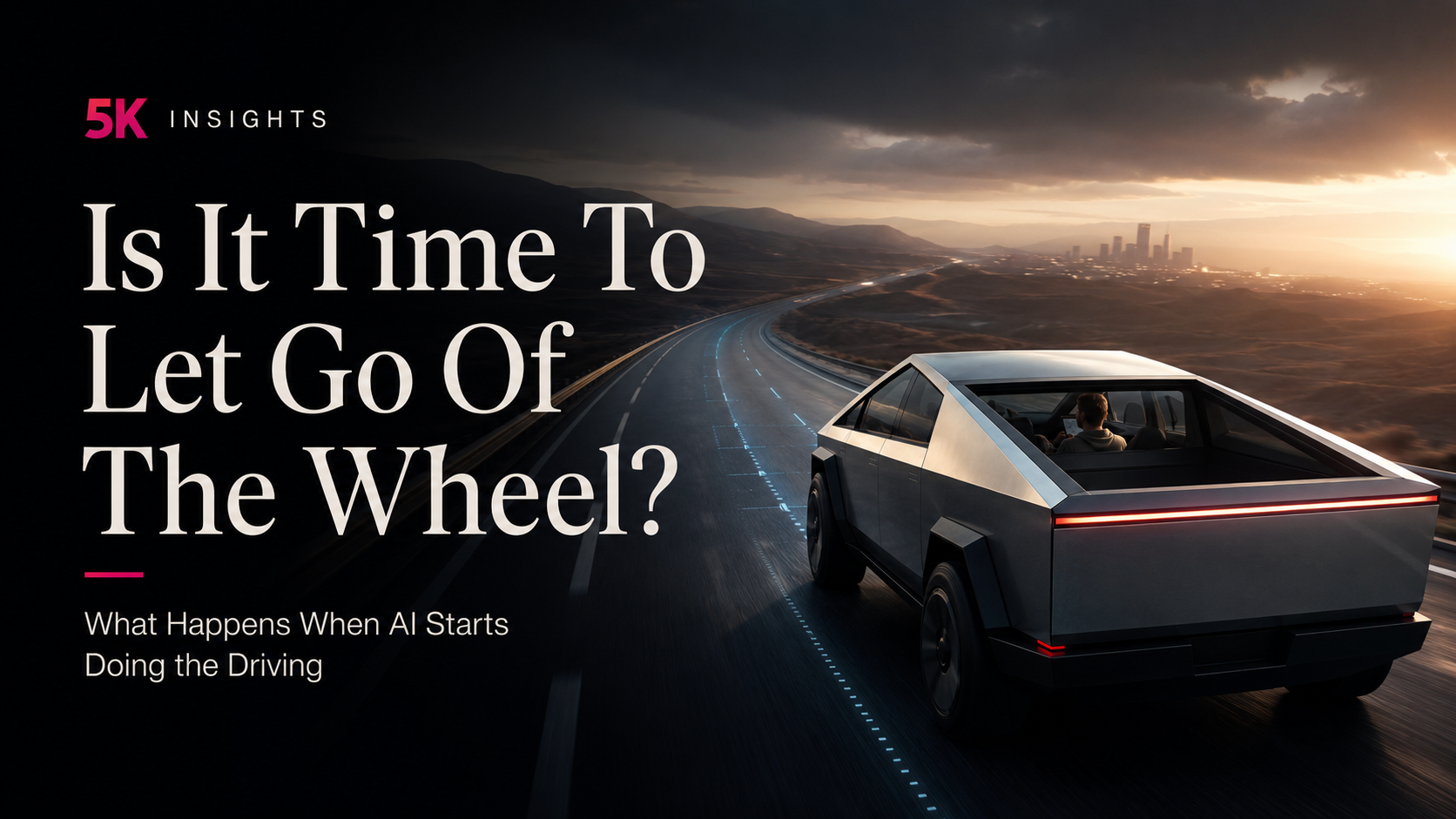
A few months back, I borrowed Dave Conklin's Cybertruck to drop something off — nothing glamorous, just hauling a Blackstone griddle back from the office after a cookout. Before I left, he asked if I was going to use the self-driving. I asked him how he felt about it when he first got the truck, whether it took him any time to actually trust it.
His answer came without hesitation: "Oh yeah, I do long road trips with it. But you have to remember — my risk tolerance is extremely high."
That answer stuck with me.
Entrepreneurs Don't Just Accept Risk. They See It Differently.
The popular version of the entrepreneur risk story is a little too simple. The idea that founders and business owners are just wired to be more comfortable with danger doesn't hold up when you look at the research. What the data actually shows is more interesting and more useful.
A study published in the Proceedings of the National Academy of Sciences found that entrepreneurs don't simply accept the same risks that stop other people. When shown identical business scenarios, entrepreneurs consistently estimated the probability of failure 15 to 30 percent lower than non-entrepreneurs did. They're not braver. They see the situation differently. They weight the downside less heavily and are faster to recognize what a new system makes possible rather than focusing on what could go wrong with it.
That's not recklessness. It's a different cognitive frame. And it shows up far beyond just starting companies.
It shows up in technology adoption. Higher-income professionals, the demographic that skews heavily toward business owners, are among the most likely early adopters of new technology, according to Pew Research. Adults earning $150,000 or more are 39 percent more likely than average to describe themselves as someone who tries new technology before most people do.
That pattern shows up clearly inside Tesla's fleet, too. The adoption rate for Full Self-Driving among Model S and Model X buyers (Tesla's premium tier, starting at $80,000) has crossed 50 percent. More than half of the people buying the expensive Teslas are activating the self-driving. Those buyers are a specific type of person, broadly the same type of person who starts and scales companies.
But Risk Tolerance Isn't Actually the Point
Here's what keeps coming back to me, though. The reason Dave does long road trips with FSD isn't just because he's comfortable with uncertainty. It's because he understands exactly what the system does for him.
A self-driving car doesn't just replace your hands on the wheel. It takes the task of physically operating a vehicle from point A to point B and removes it from your attention entirely, so you can put that attention somewhere else. You can be on a call. You can think through a problem you've been putting off. You can just decompress. The execution gets handled. You stay focused on what actually matters.
That's a distinction most entrepreneurs already understand intuitively, because they've been applying the same logic to their businesses for years. Hire people to handle what doesn't need your direct attention. Build processes so things run without you in the loop for every decision. Use software to automate what used to require someone's hands. The whole operating philosophy is about creating leverage: separating yourself from execution so you can stay focused on strategy and growth.
AI is the next version of that. And the entrepreneurs who see it clearly are moving fast.
What Real AI Automation Actually Looks Like
The version of AI most companies are running right now isn't really automation. It's access. Giving employees a ChatGPT account and calling it an AI strategy is like handing someone a car and calling it a transportation system. The tool is there, but there's no system around it.
We've written before about why so many AI implementations fail to produce results and the pattern is almost always the same. Companies start with the tool instead of starting with the problem. They run a pilot that gets a round of applause in a meeting, and then quietly disappears before it ever becomes part of how the business actually operates. We call it the AI pilot graveyard, and it's filling up fast.
A real AI system looks different. It starts with a specific workflow that's costing your team time every week, maps how that work currently gets done, and builds something that handles it automatically: a sales assistant that follows up with leads and surfaces the ones ready to buy, a reporting tool that pulls from every platform your team watches and tells you what needs to change before you even ask, an estimating tool that does in two minutes what a senior employee used to spend forty-five on.
The numbers behind this kind of implementation are real. Research across AI-using small and mid-size businesses shows that 58% of companies that have built actual automation workflows are recovering more than 20 hours of work every month. Managers using AI tools save an average of 7.2 hours per week. And according to Salesforce's 2025 data, 91% of small businesses using AI said it boosted revenue. Businesses investing in real automation, not just tool licenses, are reporting an average ROI of 250% within the first 18 months.
That's the difference between a trial and a system. One creates curiosity. The other creates return.
The Mental Shift That Separates the Companies Winning With AI
The business owners getting real results from AI have already made a specific mental shift. They stopped asking "what can AI do?" and started asking "what in our company requires a human that shouldn't?"
Repetitive data entry. Lead follow-up. Budget pacing reports. Document review. Quote preparation. Scheduling. Customer inquiry routing. Most of these tasks don't need a person to do them. They need a person to build the system that handles them, and then to step in for the exceptions and judgment calls the system can't make. That's it.
That's the self-driving car model applied to your operations. You trust the system to handle the highway. You stay focused on where you're going.
The companies that haven't made this shift aren't falling behind because AI is hard or expensive or not ready. They're waiting because they haven't seen clearly enough what the system makes possible. That same perception gap that separates entrepreneurs on risk, naturally seeing more upside and less downside in a new system, is exactly what separates the companies winning with AI from the ones still running pilots that go nowhere. If you're watching experiments stall before they reach daily workflow, we broke down exactly why that happens here.
This Is What 5K Does
Our fractional AI service exists for exactly this moment. Most business owners we talk to already know they should be moving faster on automation. They've seen the results others are getting. They've felt the drag of manual processes that shouldn't still require a person's time. What they're missing is someone who understands both AI and how their specific business actually operates and can build something that works inside both.
We come in, learn the workflows, identify the highest-value automation opportunities, and build systems your team actually uses every day. Not demos. Not experiments waiting on six months of internal buy-in. Working systems, connected to your real operations, producing real return. Learn more about how we approach AI and automation work with clients.
The goal is the same thing Dave gets from FSD on his Cybertruck: get your company from where it is to where it's going, and hand back the time the execution was consuming so you can stay focused on the work that only you can do.
The Question Worth Sitting With
If you've been circling AI without committing, the honest question isn't really about the technology. It's whether you're ready to trust a system to handle work that doesn't need your hands on it anymore, and whether you can see clearly enough what becomes possible when that work is off your plate.
The entrepreneurs who adopt self-driving technology aren't doing it because they're comfortable with danger. They're doing it because they've looked at the system, understood what it frees up, and decided the upside is obvious. They see it before most people do.
That instinct isn't limited to vehicles. It's the same instinct that built their companies. And it's going to be the same instinct that separates the businesses that scale well over the next few years from the ones that stay stuck doing manually what doesn't need to be done manually at all.
The car can drive.
5K Team
Our team helps companies to increase revenue, decrease costs, increase efficiency, and scale employees using digital marketing and AI technology.
Tags
Ready to Grow Your Business?
SCHEDULE A GROWTH STRATEGY SESSIONMost Recent Articles

The PPC Audit Most Companies Never Get: What a Real One Includes and How Long It Should Take
October 7, 2026
Read More
Two Agencies, One Sale: How to Split SEO and PPC Without Paying Twice for the Same Customer
October 7, 2026
Read More

5 Questions to Ask Your PPC Agency: How to Tell a Real Answer From a Polished Dodge
October 7, 2026
Read More