
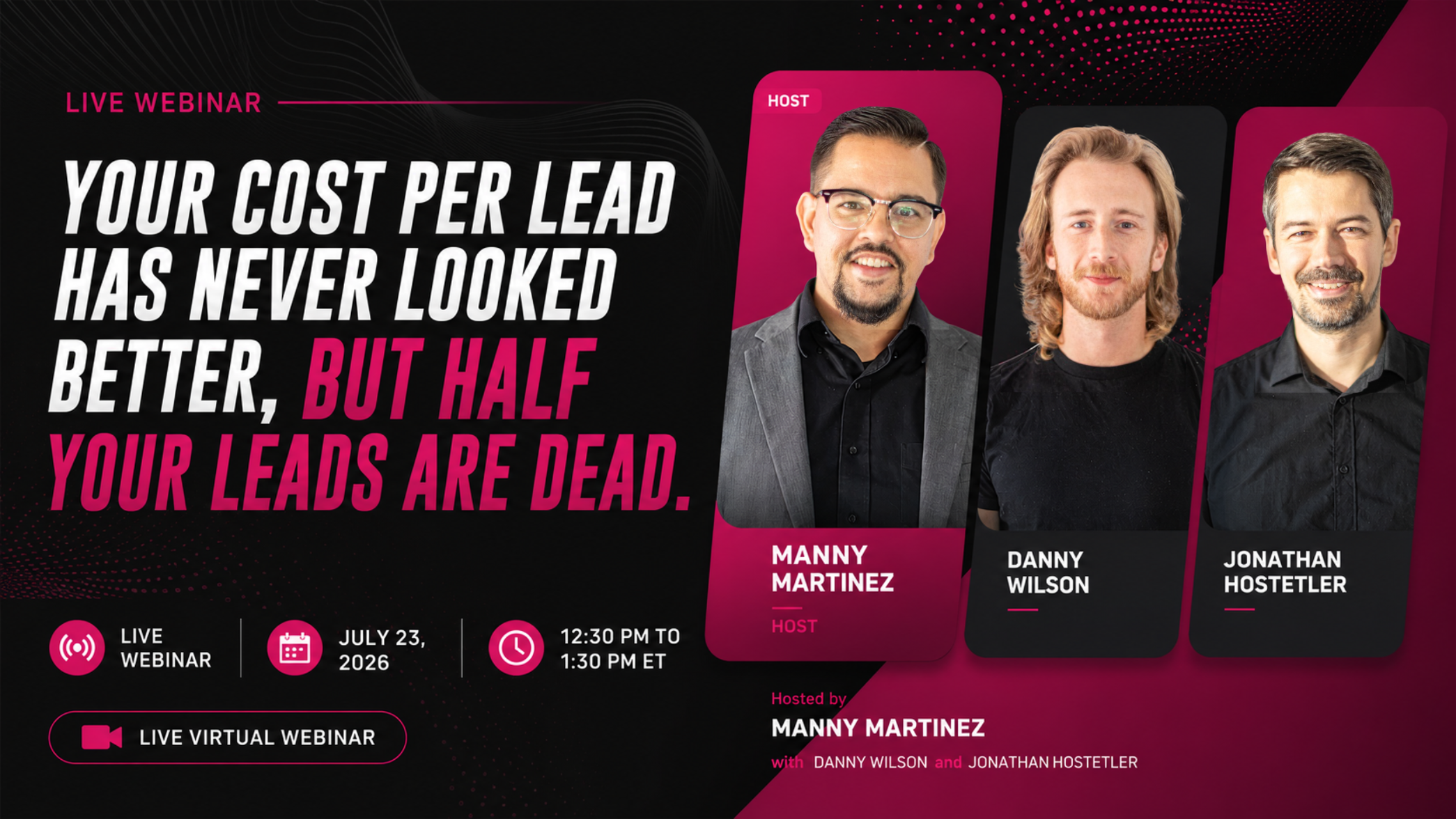
July 23, 2026
Your Cost Per Lead Is Down. So Why Is Your Pipeline Still Empty?
A lower cost per lead does not always mean better marketing. Learn how poor lead quality, slow follow-up, and bad data drain your sales pipeline.
Your Dashboard Looks Great. Your Pipeline Does Not.
Your advertising dashboard is glowing green. Lead volume is climbing. Your cost per lead is dropping. Every surface-level metric says your campaigns are winning.
Then the leads reach your sales team.
The phone numbers do not work. Prospects never answer. Some people do not remember filling out the form. Others were simply browsing and never had any intention of buying.
The dashboard says success. The pipeline says otherwise.
That gap is where companies waste enormous amounts of money. A falling cost per lead can look like a major marketing victory while hiding serious problems underneath the surface.
A Lower Cost Per Lead Can Be a Warning Sign
Advertising platforms are built to deliver the result you ask them to deliver.
If you tell Google, Meta, or Microsoft Ads that every form submission is a successful conversion, the platform will find more people who are likely to submit that form.
It may even get incredibly good at producing those submissions for less money.
That does not mean it is finding better customers.
The platform does not automatically understand the difference between a valuable prospect, a curious researcher, and a bot. Unless your tracking system provides that context, each submission looks equally valuable.
Your cost per lead can improve at the exact same time your lead quality collapses.
Most Broken Pipelines Fail in Three Places
When marketing is generating leads but sales is not generating revenue, the problem usually appears in three areas.
First, the business is capturing low-quality, low-intent, or fraudulent leads.
Second, the sales team is failing to respond while legitimate prospects are still interested.
Third, the business is not sending accurate lead-quality data back to the advertising platforms.
These are not separate problems. They are connected parts of the same revenue system.
A company cannot fix its pipeline by improving ads alone. Lead capture, follow-up, and data must work together.
Junk Leads Often Enter at the Form
Bots, automated submissions, accidental clicks, and low-intent visitors can quietly inflate your conversion numbers.
Every one of those submissions may be recorded as a successful lead. The platform sees the conversion, assumes it did its job, and begins searching for more people who behave the same way.
Without the right controls, your campaign can train itself to generate more junk.
Your forms should include bot protection, properly configured conversion tracking, and at least one qualifying question that cannot be completed through basic autofill.
The goal is not to make the form frustrating. The goal is to create enough friction to separate real interest from meaningless activity.
Broken Tracking Makes Good Decisions Impossible
Even strong leads lose their value when your tracking system cannot accurately explain where they came from.
A conversion may fire twice. A thank-you page may fail to load. A pop-up may not trigger the correct event. A lead may be credited to the wrong campaign or platform.
Once that happens, your team begins making budget decisions with unreliable information.
A campaign may appear weak inside Google Ads while a separate attribution system shows that it is producing your strongest opportunities. Another campaign may appear highly efficient because it generates cheap form submissions, even though none of those leads become customers.
You cannot improve what you cannot accurately see.
The Platform Needs to Know What a Qualified Lead Looks Like
Your advertising platform should not optimize around every person who fills out a form.
It should optimize around the people your company actually wants.
That requires a qualification feedback loop.
When a lead enters your CRM or tracking system, someone should determine whether that person fits your target customer profile. That decision should then be sent back to the advertising platform.
This changes the instruction from "find more people who submit forms" to "find more people who resemble our best prospects."
That is a completely different campaign.
Cost per Qualified Lead Is the Metric That Matters
Imagine one campaign generates 100 leads at $50 each. Another generates 50 leads at $80 each.
At first glance, the first campaign looks like the obvious winner.
Now look at lead quality.
Only 10 leads from the first campaign are qualified. That means the cost per qualified lead is $500.
Thirty-five leads from the second campaign are qualified. That puts the cost per qualified lead at roughly $114.
Lead volume made the weaker campaign look successful.
Cost per qualified lead reveals what the company is actually buying. It connects advertising spend to the quality of the opportunities reaching the sales team.
That is the number leadership can trust.
Good Leads Still Die When Follow-Up Is Slow
Fixing lead quality is only the beginning.
Many legitimate leads are called bad because nobody contacted them while they were still interested.
The moment a prospect submits a form, their attention starts moving somewhere else. They return to work. They begin researching another provider. They answer a call from your competitor.
They may have submitted forms to three or four companies during the same research session.
The first company to respond has the opportunity to control the conversation.
A prospect who was highly interested at 10:00 a.m. may appear completely cold by the following afternoon.
That is not always a lead-quality problem.
It is often a speed-to-lead problem.
The First Five Minutes Are Critical
Every legitimate inbound lead should receive an immediate automated response and a human call attempt within five minutes during business hours.
The strongest teams move even faster.
The first 60 seconds after a form submission are incredibly valuable because the prospect is still thinking about the problem. They may still have your website open. They may be waiting for someone to contact them.
An automated email creates speed. A knowledgeable salesperson creates trust.
You need both.
Give Prospects the Power to Book Immediately
A confirmation page should do more than display a basic thank-you message.
It should allow the prospect to schedule a conversation immediately.
Adding a calendar to the confirmation screen gives high-intent prospects a clear next step while their motivation is at its highest.
The same scheduling link should also appear in the automated welcome email.
Every unnecessary step between the form submission and the sales conversation gives the prospect another opportunity to disappear.
Make the next action obvious. Make it easy. Make it immediate.
One Call Is Not a Follow-Up Strategy
Many sales representatives make one call, leave one voicemail, and move on.
That is not enough.
A prospect may be in a meeting, driving, speaking with a customer, or simply unable to answer at that exact moment.
A missed call does not mean the lead is unqualified.
A strong follow-up process combines calls, emails, voicemail, scheduling links, and relevant social touches across approximately 14 days.
The goal is not to bombard the prospect. The goal is to create several reasonable opportunities for someone who requested information to continue the conversation.
A lead should not be marked dead until the complete follow-up process has been executed.
Every Lead Needs One Clear Owner
A process without ownership is only a suggestion.
Every inbound lead should be assigned to one specific person. That person should receive an alert within seconds and know exactly what happens next.
The business should clearly define who makes the first call, how quickly the call must happen, what happens if the owner is unavailable, how after-hours leads are handled, how many attempts are required, and where each interaction is recorded.
These steps should live inside the CRM as tasks and automated workflows.
They should never depend on memory.
Sales Feedback Must Be Specific
Marketing cannot improve campaigns without clear information from sales.
Saying "the leads are bad" is not useful.
The marketing team needs to know which leads were unqualified and exactly why.
Was the company too small? Was the prospect looking for something you do not offer? Was the budget unrealistic? Was the contact information fake? Was the prospect qualified but simply not ready to buy today?
That level of detail allows marketers to improve targeting, ad copy, landing pages, form questions, and campaign structure.
Vague frustration creates arguments.
Specific feedback creates better campaigns.
Marketing and Sales Must Work as One Team
Marketing sees traffic and conversions. Sales sees conversations and objections. Leadership sees revenue.
No single group sees the entire customer journey on its own.
That is why marketing and sales need a shared process for reviewing leads.
Marketing should understand what happens after the form is submitted. Sales should understand how its feedback affects targeting and campaign optimization.
When both teams communicate openly, the entire system becomes more effective.
Marketing generates better prospects. Sales follows up faster. The advertising platforms receive better data.
Everyone wins.
MQL and SQL Data Serve Different Purposes
A marketing-qualified lead, or MQL, is the type of person your company wants more of.
They fit your target customer profile, even if they are not ready to purchase immediately.
A sales-qualified lead, or SQL, fits the target profile and has demonstrated a stronger intention to buy.
Early in a campaign, optimizing around MQLs often gives the platform enough data to identify valuable prospects.
As more data becomes available, the company can begin optimizing toward deeper outcomes such as sales-qualified opportunities, proposals, or closed revenue.
The closer the optimization signal gets to actual revenue, the more powerful the advertising system becomes.
Sales Accountability Protects Your Ad Spend
Companies often assume that every lead assigned to sales received proper follow-up.
That assumption must be supported by data.
Leadership should know how quickly each lead was contacted, how many attempts were made, which channels were used, and what happened after contact.
This is not about attacking the sales team.
It is about finding the point where the process is breaking.
A company can spend thousands of dollars generating legitimate opportunities and still blame its advertising when the real problem is inconsistent sales execution.
Accountability protects the money, time, and effort invested by both teams.
Four Numbers Expose the Real Problem
Companies diagnosing a weak pipeline should begin with four operational metrics.
Speed to first touch: How much time passes between the form submission and the first response?
Five-minute call rate: What percentage of inbound leads receive a human call within five minutes?
Attempts per lead: How many meaningful touches happen before a lead is closed?
Connection and booking rate: What percentage of leads are reached, and how many schedule a real sales conversation?
These numbers quickly show whether the business has a lead-quality problem, a follow-up problem, or both.
Without them, sales and marketing are forced to argue from assumptions.
Audit the Last 30 Days
Pull every lead generated during the last 30 days.
Determine how many were legitimate, how many fit the target customer profile, how quickly each one was contacted, how many follow-up attempts occurred, and how many became appointments or opportunities.
Then calculate your marketing-qualified lead rate.
If 100 leads were generated and only 40 were qualified, your MQL rate is 40 percent. That suggests your targeting, messaging, forms, or campaign structure need attention.
If 80 leads were qualified but only a small percentage received proper follow-up, the larger problem is inside the sales process.
The audit turns a vague complaint into a clear diagnosis.
Stop Celebrating Cheap Form Submissions
The cheapest lead is not always the best lead.
A successful customer acquisition system does not end when someone clicks submit. It continues through qualification, follow-up, appointment setting, sales, and revenue attribution.
Your advertising platform needs clean conversion data.
Your sales team needs a clear and accountable follow-up process.
Your marketing team needs specific feedback from every stage of the pipeline.
When those systems work together, cost per qualified lead improves, sales receives better opportunities, and leadership gains numbers it can confidently use.
A falling cost per lead may look impressive in a report.
A growing pipeline is what proves the marketing is working.

5K Team
Our team helps companies to increase revenue, decrease costs, increase efficiency, and scale employees using digital marketing and AI technology.
Tags
Ready to Grow Your Business?
SCHEDULE A GROWTH STRATEGY SESSIONMost Recent Articles

The PPC Audit Most Companies Never Get: What a Real One Includes and How Long It Should Take
October 7, 2026
Read More

Two Agencies, One Sale: How to Split SEO and PPC Without Paying Twice for the Same Customer
October 7, 2026
Read More

5 Questions to Ask Your PPC Agency: How to Tell a Real Answer From a Polished Dodge
October 7, 2026
Read More