The AI tool landscape in 2026 is overwhelming.
We’re digital marketers and business growth consultants, and I’m here to tell you: it is overwhelming (isn’t it nice to know you’re not alone…)
Every week brings a new platform promising to automate your marketing, optimize your ads, or replace half your team (or at least Joan in Accounts Receivable). If you are a small business owner or e-commerce founder trying to separate signal from noise, the sheer volume of options can feel paralyzing, and paralysis is expensive (it’s also a super frustrating feeling).
Here is the reality: you do not need twenty AI tools.
You need maybe five — at least to start with. And you need them working together around a clear growth strategy. The tools below are not hypothetical. They represent the categories where AI is delivering measurable ROI for small businesses and DTC brands right now, across ad management, attribution, content, customer intelligence, and search visibility. Some are tools 5K uses daily with clients. Others are strong options on the market worth evaluating for your stack.
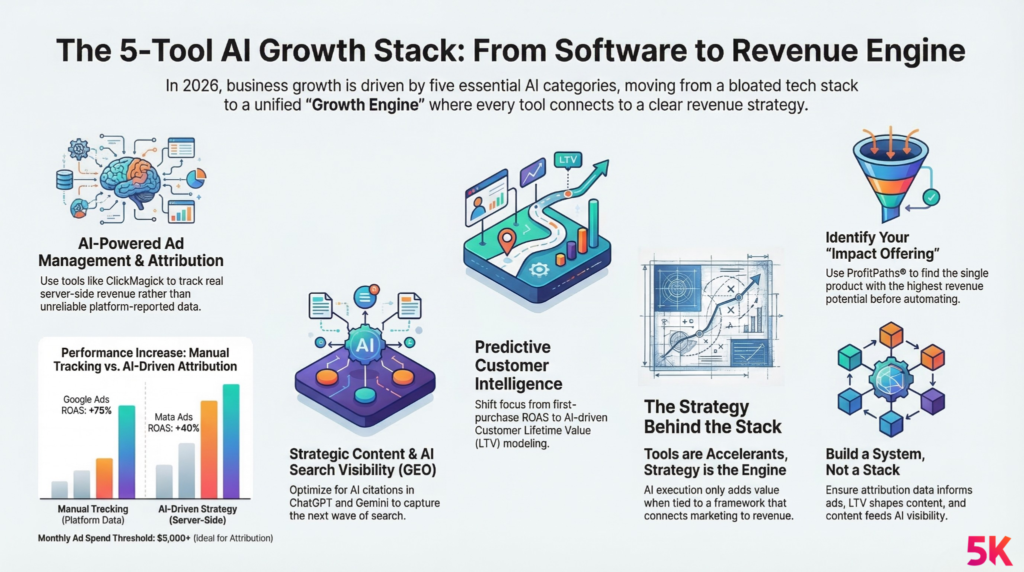
If you walk away from this article with one takeaway, let it be this: the value of AI tools is not in the tools themselves. It is in how they connect to a strategy that ties every marketing dollar to revenue. That is the difference between adding software and building a growth engine.
1. AI-Powered Ad Management: Let the Machine Optimize the Bids
Manual bid management on Google Ads and Meta Ads is increasingly a losing strategy for small businesses. The platforms themselves are pushing toward AI-driven campaign types — Google’s Performance Max, Meta’s Advantage+ — and the businesses that learn to work with these systems rather than fight them are seeing materially better cost-per-acquisition numbers.
Tools like Birch and Madgicx sit on top of Meta and Google’s native platforms and add a layer of AI-driven automation for bid adjustments, audience testing, and creative rotation. They are particularly useful for DTC brands managing high-AOV product campaigns with seasonal cycles, where manual oversight cannot react fast enough to performance shifts.
The key consideration is not whether to use AI for ad management (honestly, that ship has sailed… I mean it’s way out there… like “you can’t see it from the shore and they sent a postcard” way out there). The question is whether your AI layer is optimizing toward the right goal. Most default campaign settings optimize for clicks or conversions, not for lifetime value or profit margin. This is where having a paid traffic management strategy built around revenue outcomes matters more than the specific tool you choose. 5K’s approach to paid media starts with identifying your Impact Offering through ProfitPaths® before a single ad dollar is allocated, because the best bid algorithm in the world cannot fix a campaign pointed at the wrong product.
2. Attribution and Click Tracking: ClickMagick
This is not a category recommendation. This is a specific one. ClickMagick is the attribution and click-tracking platform we use with clients at 5K, and it is one of the most important tools in the DTC and small business marketing stack.
Here is why it matters. In a post-iOS 14.5 world where platform-reported conversions are unreliable and cookie-based tracking is increasingly degraded, most small businesses are making budget decisions on bad data. They are scaling ad sets that Meta says are profitable but that are actually cannibalizing organic revenue, or they are killing campaigns that look expensive on-platform but are actually driving high-LTV first purchases.
ClickMagick solves this by providing server-side click tracking and cross-device attribution that does not depend on browser cookies or platform pixels. You get an accurate picture of which traffic sources are actually generating revenue — not just conversions, but real revenue tied to real customer behavior. For e-commerce founders stuck on unsustainable CAC on Meta and Google, this kind of clarity is not optional. It is the foundation for every other optimization decision you make.
If you are spending more than $5,000 per month on paid media and you are not running independent attribution, you are almost certainly making allocation decisions on incomplete data.
Learn how we used ClickMagick to increase a client’s Google ROAS by 78% and their Meta Roas by almost 40%.
Ad Performance Comparison: Before and After ClickMagick Implementation
Case Study Highlights:
- Meta Ads ROAS increased by 39.44% (from 2.13x to 2.97x)
- Google Ads ROAS increased by 78.45% (from 6.45x to 11.51x)
- Improvements observed in CAC, AOV, CPC, EPC, and SCR across channels
- ClickMagick tracking provided accurate attribution data
- Enabled proper optimization and alignment with real sales data
3. AI Content and Copy Generation: Strategic, Not Spray-and-Pray
AI writing tools have matured significantly since the first wave of GPT-powered content mills. Platforms like Jasper, Writer, and Copy.ai now offer brand voice controls, campaign-level content planning, and integration with ad platforms and CMS systems. For small businesses without a full content team, these tools can dramatically reduce the time from content strategy to published asset.
But here is the caveat that most “best AI tools” articles will not tell you: AI-generated content without a strategic framework behind it is just faster mediocrity. Welcome to AI SLOP WORLD 2.0 (we have musical artists now too!)
The output is only as good as the input, and the input that matters most is not a clever prompt. It is a clear understanding of which audience you are writing for, which stage of the funnel the content serves, and how it connects to a revenue-generating action.
This is the thinking behind 5K’s ProfitPaths® methodology. Before producing content, you need to identify your Impact Offering — the single product or service with the highest combination of revenue potential and competitive positioning — and build your content calendar around supporting that offering’s buyer journey. AI writing tools accelerate execution. Strategy determines whether what you execute is worth accelerating.
👇 Learn more about structuring content to rank in LLMs in this 5K Five video
4. Customer Intelligence and LTV Analytics
Knowing your customer acquisition cost is table stakes. Knowing your customer lifetime value segmented by acquisition channel, first product purchased, and time-to-second-purchase — that is where growth decisions get made.
Platforms like Lifetimely (now part of the Triple Whale ecosystem) and Daasity give DTC brands AI-powered cohort analysis, predictive LTV modeling, and retention forecasting. They pull data from Shopify, ad platforms, and email/SMS tools to build a unified picture of customer value over time.
Why does this matter for small businesses specifically? Because when your ad budget is limited, you cannot afford to optimize for first-purchase ROAS alone. A product that costs $80 to acquire a customer but generates $400 in LTV over 12 months is a fundamentally different investment than a product with the same CPA but no repeat behavior. Without LTV analytics, you treat both identically — and you systematically underinvest in your most profitable growth lever.
If you are running a high-AOV e-commerce brand with repeat purchase potential, LTV analytics should be the second tool you implement after attribution. The combination of ClickMagick’s accurate channel-level data and LTV-aware analytics creates a feedback loop where every ad dollar is evaluated against long-term revenue, not just short-term conversion metrics.
5. AI Search Visibility and SERP Tracking: Spotlight by 5K
This is the category most small businesses are not tracking at all yet, and it may be the most consequential one for the next two years.
As AI search engines like ChatGPT, Gemini, and Perplexity become primary research tools for buyers, your brand’s visibility is no longer defined solely by where you rank on Google’s results page. It is defined by whether AI platforms cite you when answering questions in your category. This is the core premise of Generative Engine Optimization (GEO), and most businesses have zero visibility into how they perform in this new landscape.
5K Analytics is our proprietary analytics dashboard built specifically to solve this problem. Spotlight tracks both traditional SERP positioning and AI citation visibility across major AI platforms, giving you a unified view of where your brand appears when buyers search, whether they search on Google or ask ChatGPT. For our clients, ths is the command center that connects GEO strategy to measurable outcomes: which pages are being cited, which queries trigger your brand, and where you are losing visibility to competitors.
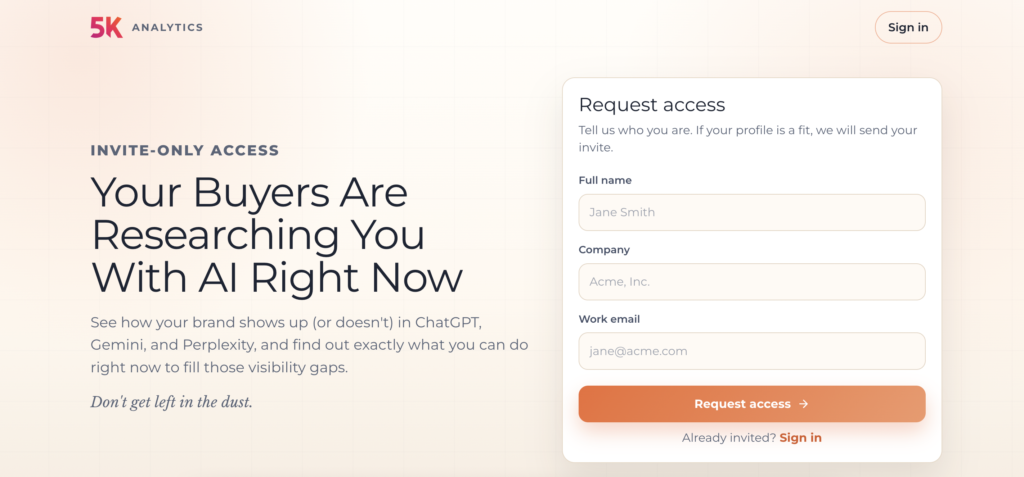
If you are not yet a 5K client but want to understand the landscape, tools like Otterly.ai and Peec AI offer emerging (though somewhat limited) solutions for monitoring AI search mentions. The category is new and evolving fast. But the underlying principle is not: you cannot improve what you do not measure. And in 2026, if you are not measuring AI visibility alongside traditional SERP performance, you are navigating with a map that is missing half the territory.
5K’s GEO and SEO services are built around this dual-visibility model, ensuring that your content performs in both traditional search and the AI-driven research environments that are rapidly becoming the default for B2B and high-ticket DTC buyers.
| Category | Tool Name | Key Features | Primary Use Case | Target Audience | Benefit | Strategic Importance |
| Attribution and Click Tracking | ClickMagick | Server-side click tracking and cross-device attribution independent of cookies or pixels. | Providing an accurate picture of traffic sources generating real revenue in a post-iOS 14.5 environment. | DTC and small businesses spending >$5,000/month on paid media. | Increased Google ROAS by 78% and Meta ROAS by almost 40%. | The foundational data layer for the RAMP!™ roadmap, ensuring budget allocation is based on high-LTV revenue. |
| AI-Powered Ad Management | Madgicx | AI-driven automation for bid adjustments, audience testing, and creative rotation. | Automated optimization sitting on top of Meta and Google native platforms. | DTC brands. | Materially better cost-per-acquisition through rapid automation. | Provides the technical execution for the ProfitPaths® methodology by optimizing toward revenue goals. |
| AI-Powered Ad Management | Google Performance Max | AI-driven campaign types for bid management and optimization. | Automated bid management and campaign optimization on Google Ads. | Small businesses and DTC brands. | Materially better cost-per-acquisition numbers. | Essential for executing paid traffic strategies built around revenue outcomes rather than just clicks. |
| AI-Powered Ad Management | Meta Advantage+ | AI-driven automated campaign types for social media advertising. | Optimizing cost-per-acquisition on Meta platforms. | Small businesses and DTC brands. | Improved cost-per-acquisition and efficiency over manual bidding. | Automates execution of the Impact Offering strategy at the ad level. |
| AI-Powered Ad Management | Birch | AI-driven automation for bid adjustments, audience testing, and creative rotation. | Managing high-AOV product campaigns with seasonal cycles where manual oversight is too slow. | DTC brands. | Faster reaction to performance shifts and optimized bidding. | Acts as an optimization layer to ensure paid media scales efficiently based on performance data. |
| Customer Intelligence and LTV Analytics | Lifetimely (Triple Whale) | AI-powered cohort analysis, predictive LTV modeling, and retention forecasting. | Segmenting customer value by acquisition channel and first product purchased. | DTC brands with repeat purchase potential. | Enables optimization for long-term profit rather than just first-purchase ROAS. | Identifies the high-value cohorts needed to refine the Impact Offering and ProfitPaths® strategy. |
| Customer Intelligence and LTV Analytics | Daasity | Unified picture of customer value over time by pulling data from Shopify and ad platforms. | Predictive modeling and retention forecasting for growth decisions. | DTC brands, especially high-AOV brands. | Prevents underinvestment in profitable growth levers by showing true LTV. | Provides the feedback loop necessary to evaluate the long-term success of the RAMP!™ roadmap. |
| AI Search Visibility and SERP Tracking | 5K Analytics | Tracking traditional SERP and AI citation visibility across ChatGPT, Gemini, and Perplexity. | Generative Engine Optimization (GEO) and monitoring brand citations in AI search. | B2B and high-ticket DTC buyers/brands. | Visibility into which queries trigger the brand and where visibility is lost to competitors. | The primary command center for the GEO and SEO services within the 5K growth engine. |
| AI Search Visibility and SERP Tracking | Otterly.ai | Monitoring AI search mentions. | Emerging solution for tracking brand presence in AI search environments. | Businesses looking to understand their AI visibility landscape. | Initial measurement of brand presence in new AI search territory. | An alternative monitoring tool for the early stages of a GEO strategy. |
| AI Search Visibility and SERP Tracking | Peec AI | Monitoring AI search mentions. | Tracking how brands are cited by generative engines. | Businesses exploring Generative Engine Optimization. | Measurement of brand performance in AI research environments. | Supporting tool for measuring content performance in AI-driven search. |
| AI Content and Copy Generation | Jasper | Brand voice controls, campaign-level content planning, and platform integrations. | Reducing time from content strategy to published asset for small teams. | Small businesses without a full content team. | Dramatically reduces production time for content execution. | Accelerates the execution of content designed to support the Impact Offering buyer journey. |
| AI Content and Copy Generation | Writer | Brand voice controls and integration with CMS systems. | Strategic content generation and planning. | Small businesses. | Increased speed of content deployment. | Supports the content pillar of the growth engine by automating high-quality output. |
| AI Content and Copy Generation | Copy.ai | AI writing tools with campaign-level planning features. | Content execution for marketing funnels. | Small businesses. | Strategic acceleration of content marketing efforts. | Execution tool for scaling content within the ProfitPaths® framework. |
Tools Are the Accelerant. Strategy Is the Engine.
Five tools. Five categories. But the real point of this article is not the tools themselves — it is the architecture underneath them.
Every tool on this list becomes exponentially more valuable when it operates inside a unified growth strategy. Attribution data informs ad optimization. LTV analytics shape content targeting. Content strategy feeds AI visibility. AI visibility drives organic discovery that reduces paid dependency over time. It is a system, not a stack.
This is the approach 5K takes with every client through the RAMP!™ strategic roadmap — starting with ProfitPaths® to identify the Impact Offering, then layering paid media, GEO content, and analytics infrastructure in a sequence designed to produce compounding returns rather than isolated tool-level improvements.
We Make It Easy – Schedule A Growth Strategy Session
If your current marketing feels like a collection of disconnected tools generating disconnected metrics, the problem is not the tools. The problem is the absence of a strategic framework connecting them to revenue. That is the gap worth closing first.